
Tired of tire troubles


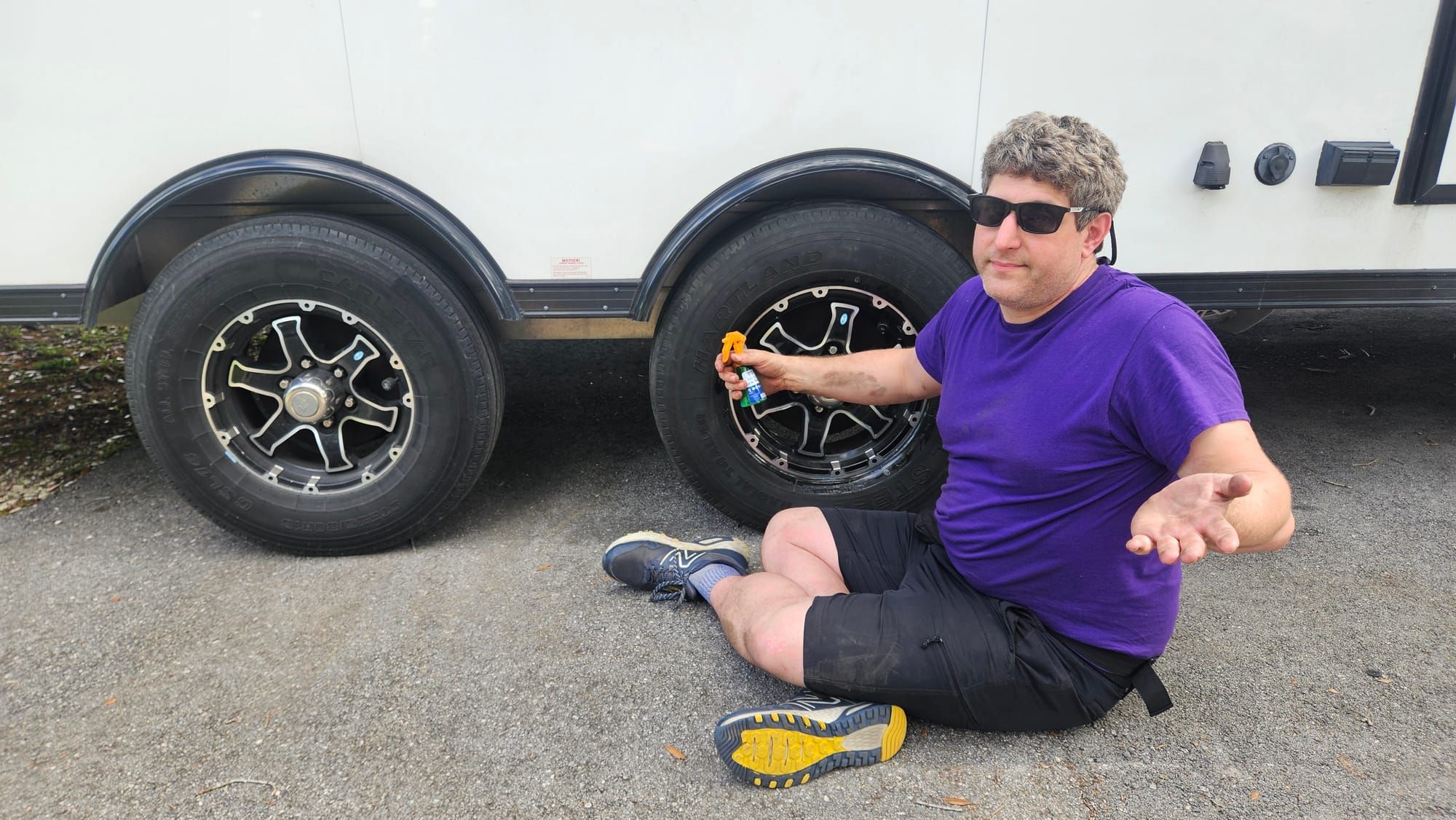
This could have been really bad (2 flat tires 2 days apart)
We were enjoying the Florida sunshine in luxury at our oceanfront campsite in Key West, but we still had a dark cloud hanging over our heads. We experienced one of the common RV nightmares: a flat tire, on a dangerous road, in a major city. Even still, we saw the silver lining. Florida's Turnpike in Miami was far better than if the flat had occurred on one of the bridges of the Overseas Highway, where we would have very few options to pull off the road. We immediately got off the Turnpike and pulled into a Race-Trac gas station, where we spent the next 2 hours changing out our flat for the spare. 2 hours just to change a tire? Oh yes. Because in the RV life, oftentimes one problem leads to another, and to another. It's the dreaded RV problems domino effect.
Thankfully, we were able to eventually get back on the road and keep up with our plans. But we wouldn't be able to ride on this spare forever. We had a lot of questions about our flat tire: Why did it go flat? Was it salvageable? Where the heck did this tire even come from?
That final question led us down a very deep rabbit hole – one that made us wonder, should we have been keeping a manifest of all our trailer tires? We had gone through a lot in the past few years, due to the fact that we kept getting uneven wear from our axle issues. Then we also had our embedded bolt in Arkansas. Obviously, these constant tire replacements meant that we were always on fresh tires, so we didn't need to worry about this tire's expiration. But we still wondered its origin. That would be one more part of the mystery to solve, and it wasn't as straightforward as we hoped. But we'll get into that a little later.
Meanwhile, we created a plan to tackle our tire troubleshooting. The best process would be to run some diagnostics, gather information, and make decisions based on that information. Down in the Keys, our resources were limited, and we definitely didn't want to travel over the bridges on a tire we couldn't trust. We decided that, no matter what, we'd keep the spare on until we got back on the mainland. However, we needed to figure out where to put ourselves after the Keys. We had nothing booked and would prefer to travel far enough to get past Miami, but Miami has the civilization we might need for repair shops, auto parts stores, etc. So we decided that Tire Troubleshooting Phase 1 needed to happen as soon as possible.
Phase 1: Tend to the tire
At our Keys campsite, we got the tire out and filled it with air to see if we could detect any leaking. Based on Nicole's observations that it looked like this wheel wasn't sitting quite right on the hub, we took a close look at the rim to make sure we saw no gaps. Nothing immediately detectable, but if the tire did need to be reset on the rim, we'd need to enlist the help of a professional. Anthony decided to call the local tire shop in Key West. If nothing else, it would be helpful to get another set of eyes on the tire.
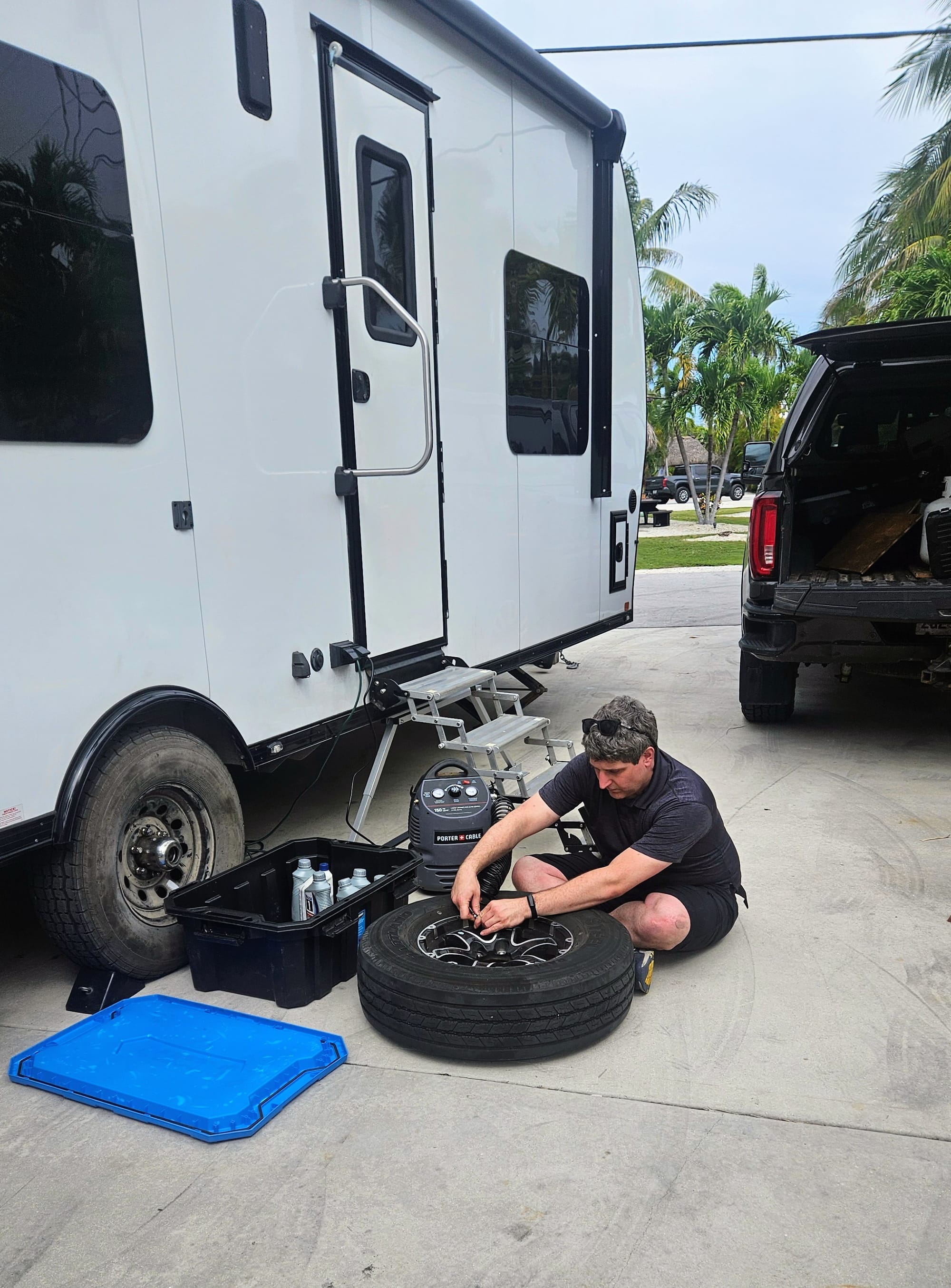
20 minutes spent at the tire shop, and we got an answer that would cause most RVers to let out a sigh of relief: the valve stem was leaking. This typically is best-case scenario. The valve stem is cheap and easy to replace, and the tire still has integrity. The tire guy agreed that the treads and sidewalls still looked good, and he tested the rim for leaks and found nothing.
But we weren't breathing a sigh of relief just yet. A leaky valve stem? On this tire? Normally, we'd just conclude that something hit the wheel as we drove through construction on the FL Turnpike. We also lost our wheel center cap plug in the process, which indicates some type of blunt force. But what about that misalignment Nicole kept seeing? It would be incredibly coincidental if we had an unrelated valve stem mishap on the same tire, and we don't believe in coincidences.
Nothing else we could do while in Key West, and so we packed the tire back in the truck bed, kept the spare on, and decided to plop ourselves back in Miami after we left. There, we could move onto Tire Troubleshooting Phase 2.
On April 15, our drive day out of the Keys, we brainstormed the history of these current tires. This was when the plot thickened. At first, Anthony recalled that all 4 tires came from Discount Tire in Spanish Fork, UT last year. While we were there for our axle repair, he had made an appointment at Discount Tire to get all 4 truck and all 4 trailer tires replaced.
But then we had a revelation. Sometimes on our drive days, we read the blog posts from that day in previous years. April 15 happened to coincide with this post. We specifically wrote that Anthony ended up only changing the truck tires, not trailer, because the axle guys told us to hold off. This did explain why our tires were different brands. We had 2 Carlstars (Carlisle brand tires manufactured post-2023), a Heartland, and a Transeagle. The one that went flat was the Heartland. This meant that we got these tires all over the place, which also meant records of our purchases would be hard to find.
We reserved 3 nights at a city park in southern Miami to give us time to run more diagnostics and go to parts places if needed. Because we use a ramp jack for our trailer, it's easiest to do work on the trailer when we're already hitched. This meant we could either jack up the trailer right after arriving, or wait until we leave. It's tough to muster the energy to jump into repairs when we're already fatigued by a drive, but we knew that anything we could do sooner would be better. We needed those 3 days to observe our tire under load, have shops nearby, and decide where we should go after Miami. Thankfully, the drive off the Keys and into Miami was only a few hours, so we had plenty of time to do what we needed to do. We hoped to park at our campsite, stay hitched, and take a post-drive break before troubleshooting. This way we could regroup while letting our tires cool. We just needed a campsite long enough to fit us while hitched.
Our truck-trailer combo is 56ft from head-to-tail, with 8ft of overhang from the rear wheels. Our parking pad was 48ft – an exact fit when we placed our rear wheels at the edge of the back of our site. Ironically, we were initially given a different site, but the staff changed it a couple hours before we arrived. During one of our campground walks, we went to find the site that could have been, and it had a large tree behind it that would have prevented overhang. Even unhitched, that site probably wouldn't have fit our truck. Whoever made the call to give us a longer campsite, we salute you! Lots of people don't catch that we need extra length because we tow a trailer – and to remain hitched for a while in our campsite was exactly what we needed to move into Phase 2 of troubleshooting.
Phase 2: Wait and watch
Our plan: put the Heartland back on, fill it to its cold temp pressure, check for leaks, and see if it loses air while parked. The Key West tire place only checked for leaks while the tire was off, so testing under load was crucial.
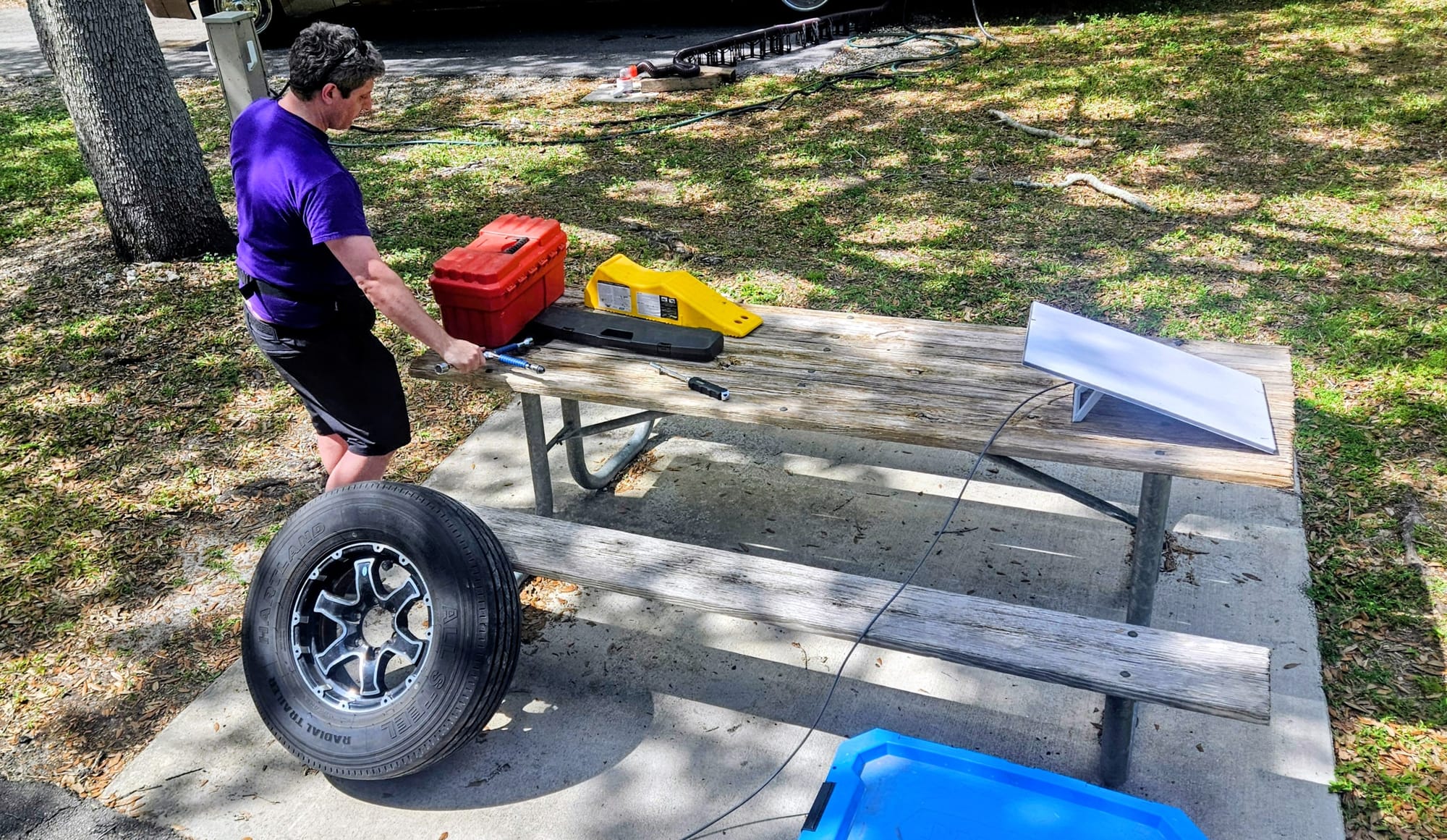
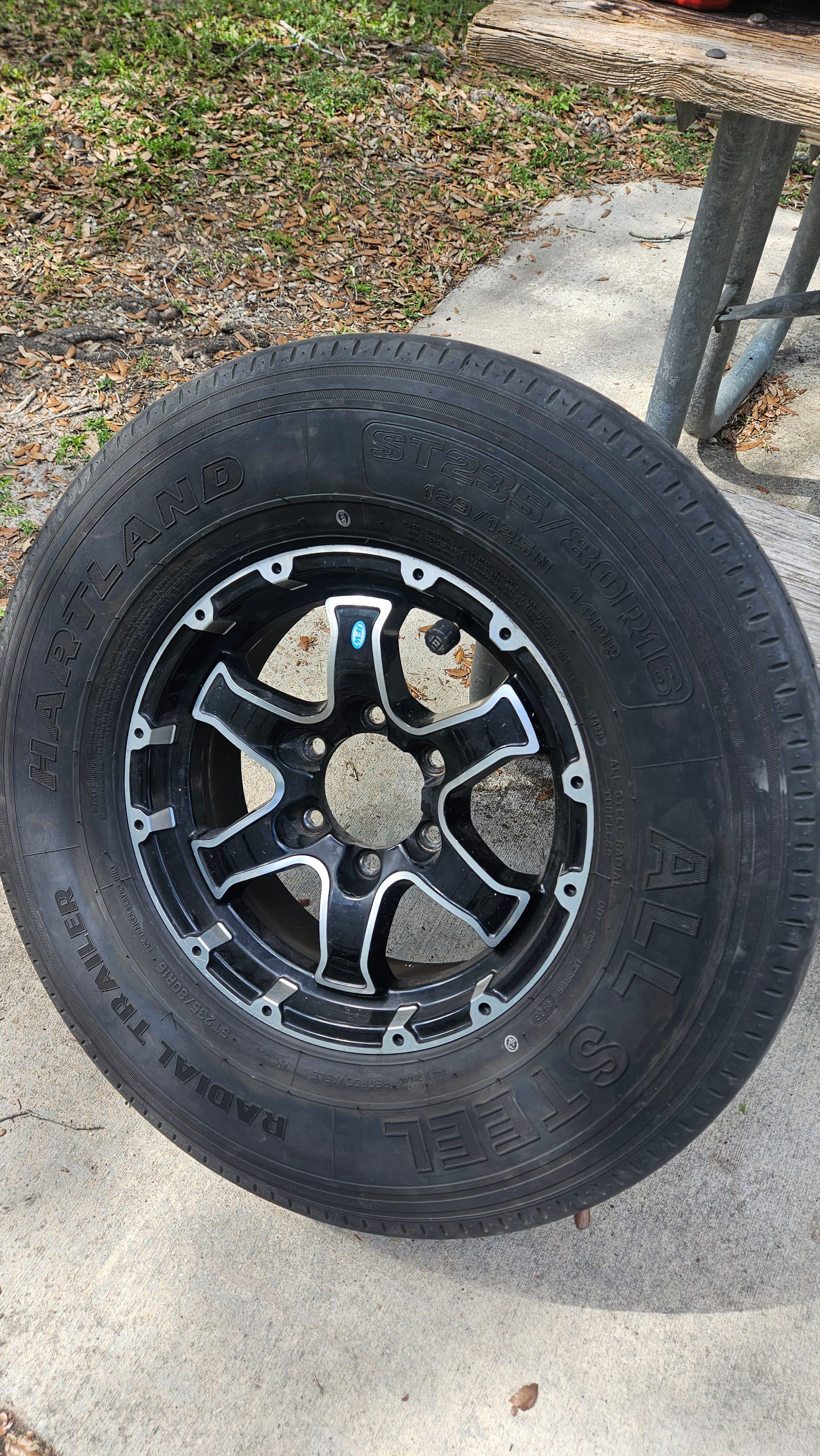
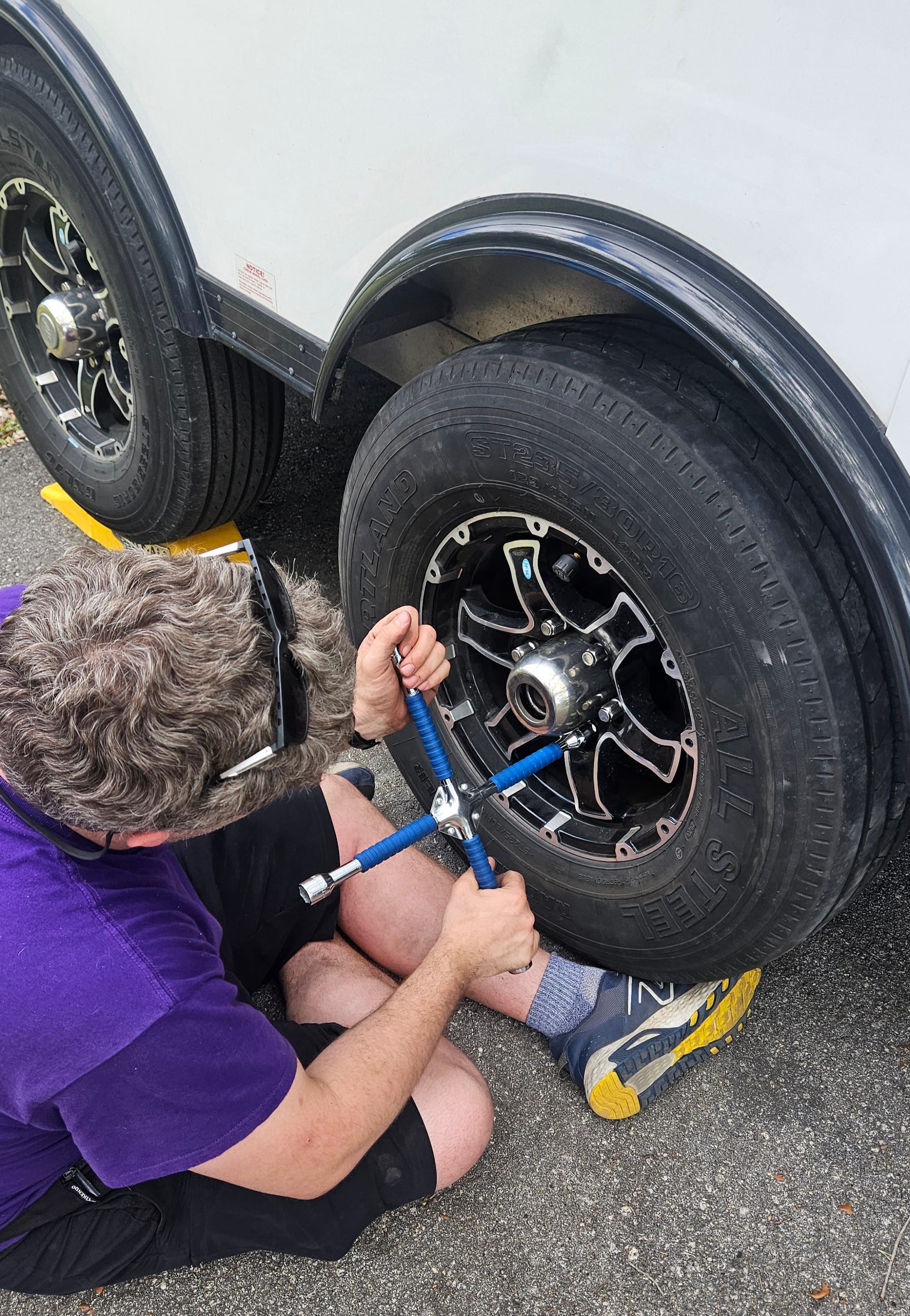
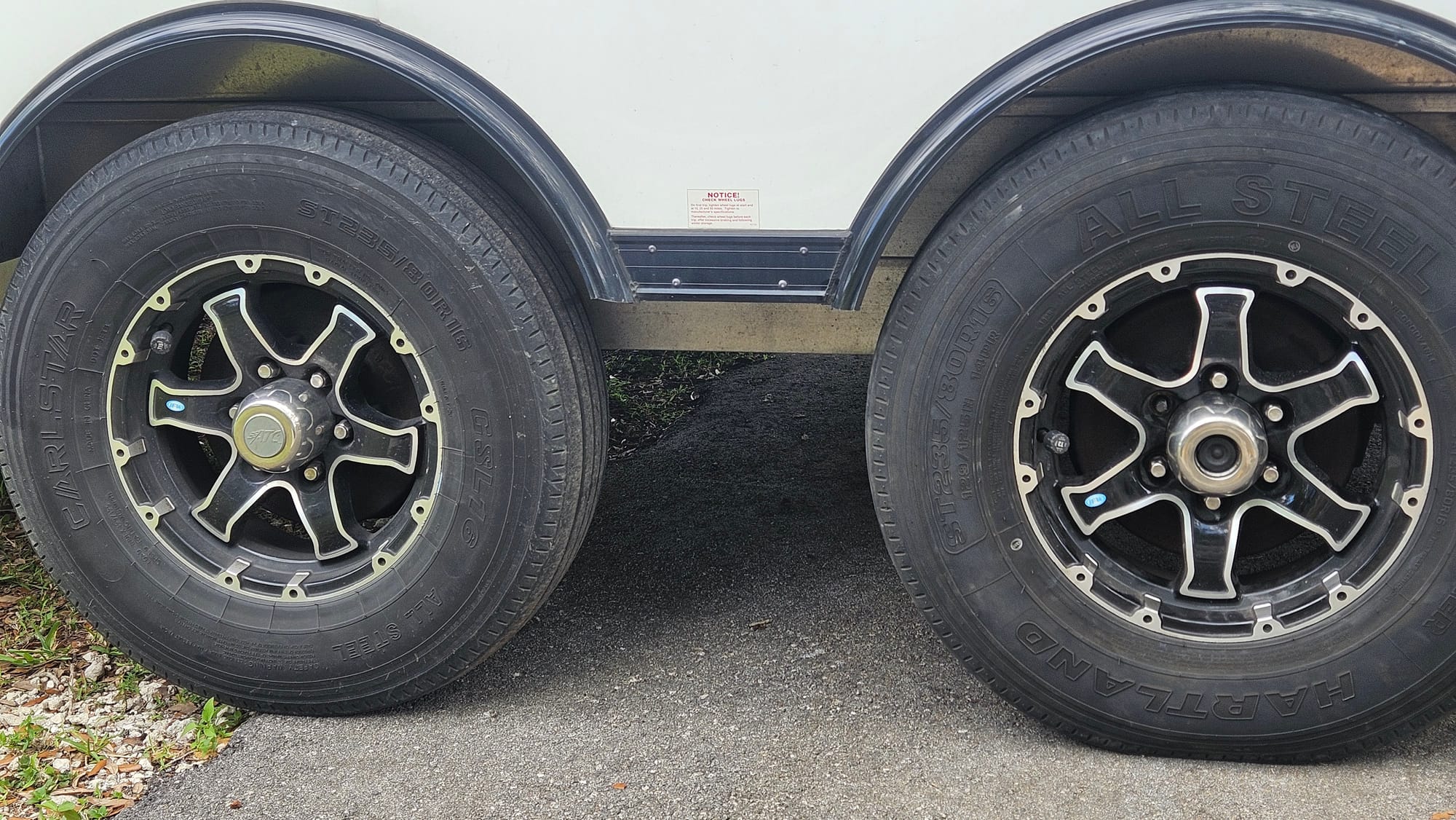
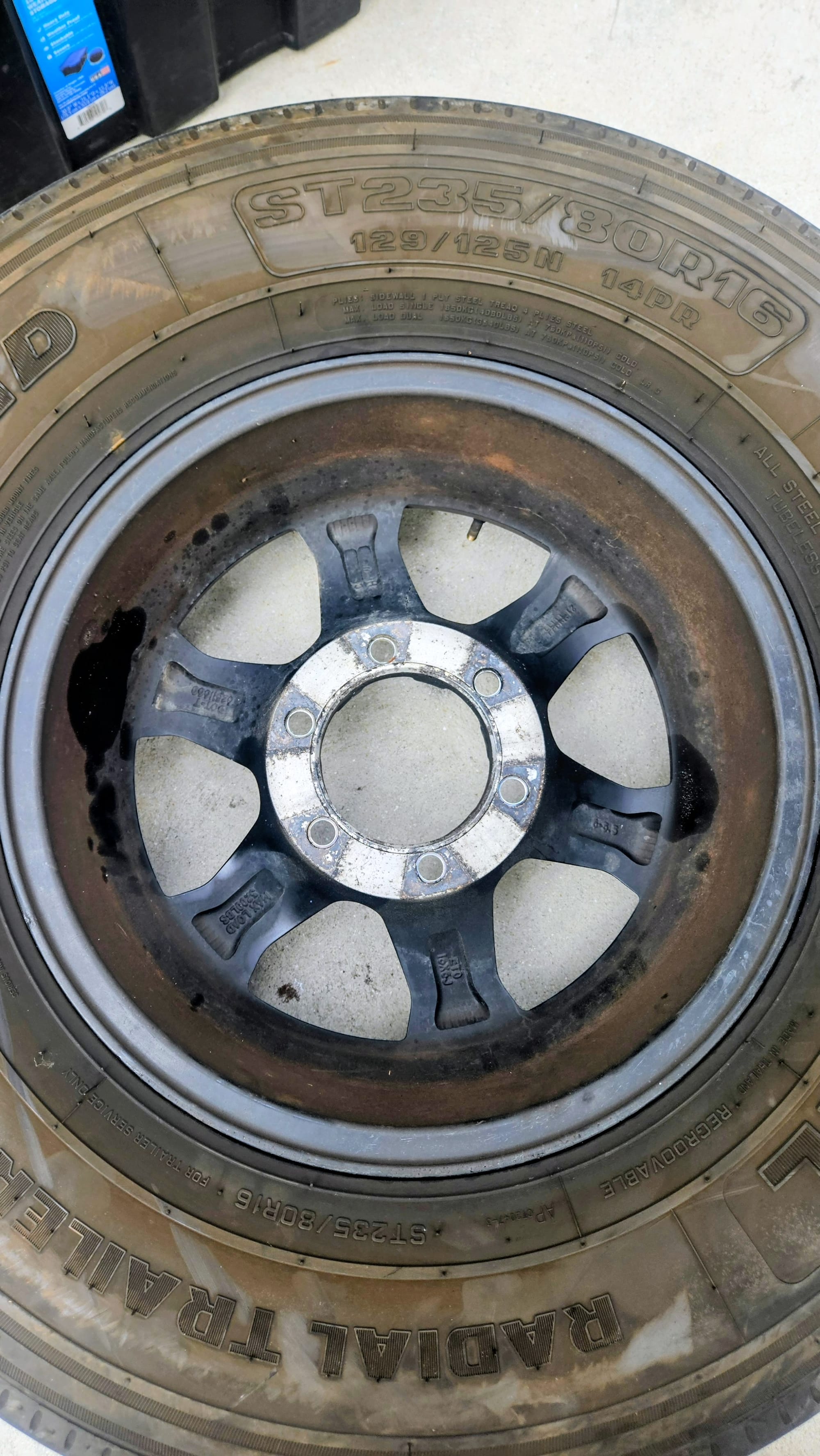
While Anthony changed the tire, Nicole checked the DOT dates of all 4 tires, hoping they'd give some indication of which tire was installed when and where. The DOT (Department of Transportation) code is a stamp in the sidewall that states the manufacture date and indicates that the tire complies with safety standards. We can use that date to calculate how many years the tire has left before it should be replaced due to degradation of the rubber. That's of course if the tire has no issues in its lifetime, which has never been the case for any of ours!
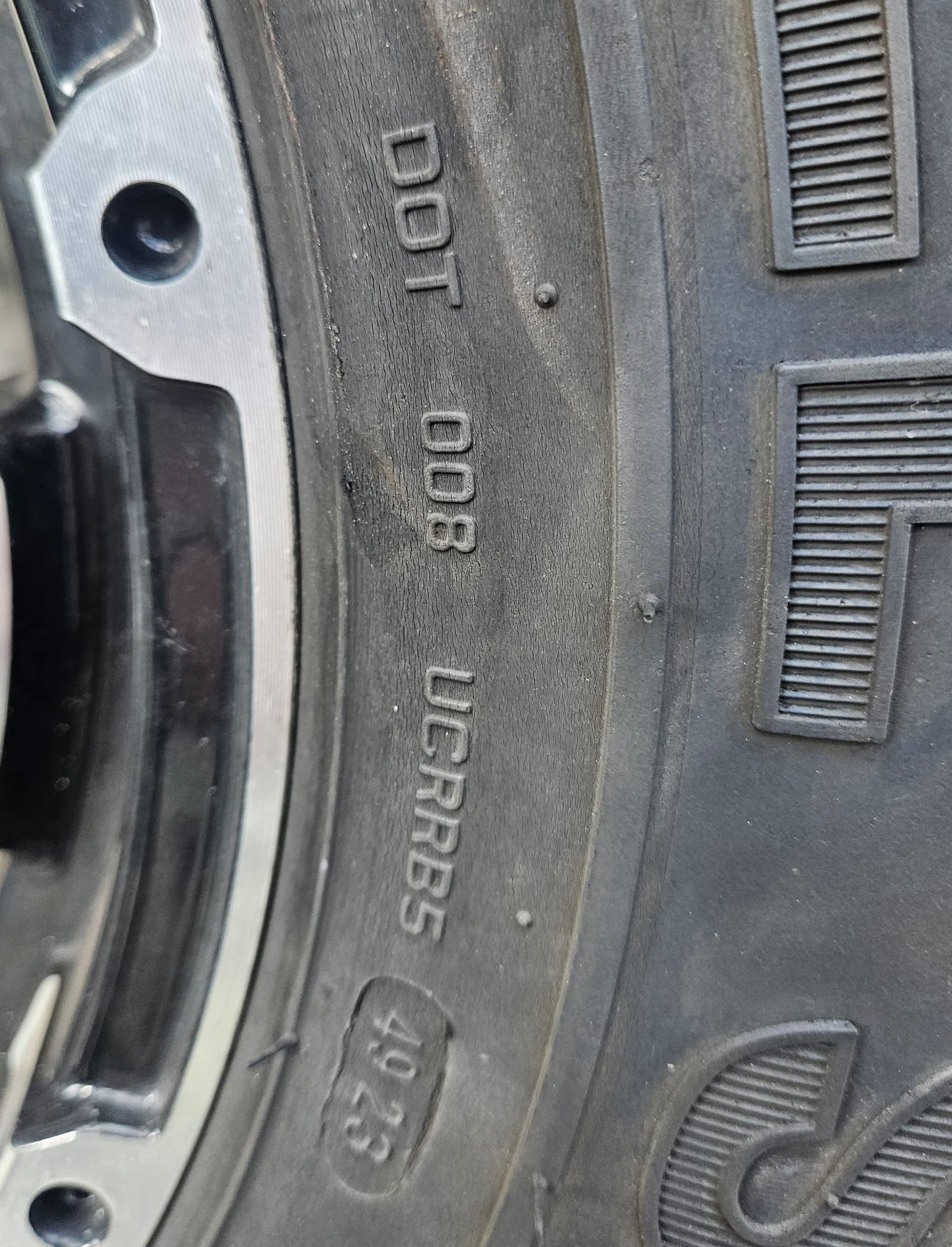
The Heartland's DOT code, 4923, meant a manufacture date in the 49th week of 2023, aka December 2023. We assumed this meant we got the tire sometime in 2024. Anthony's guess was in Arkansas after the bolt puncture. Nicole's guess was later that year in northern NH, when we noticed uneven wear and got a quick replacement at a tire shop in Colebrook.
We dove into our receipts and realized, we don't really have any. Even when we get a replacement at Discount Tire, our account doesn't seem to keep records of which tires we get when. Good thing for the blog, though, because Nicole takes lots of pictures. We dove into our albums. First, we found photos of our tire replacement in NH. It was easy to find; we changed that tire on our wedding anniversary, so the date was embedded in our minds.
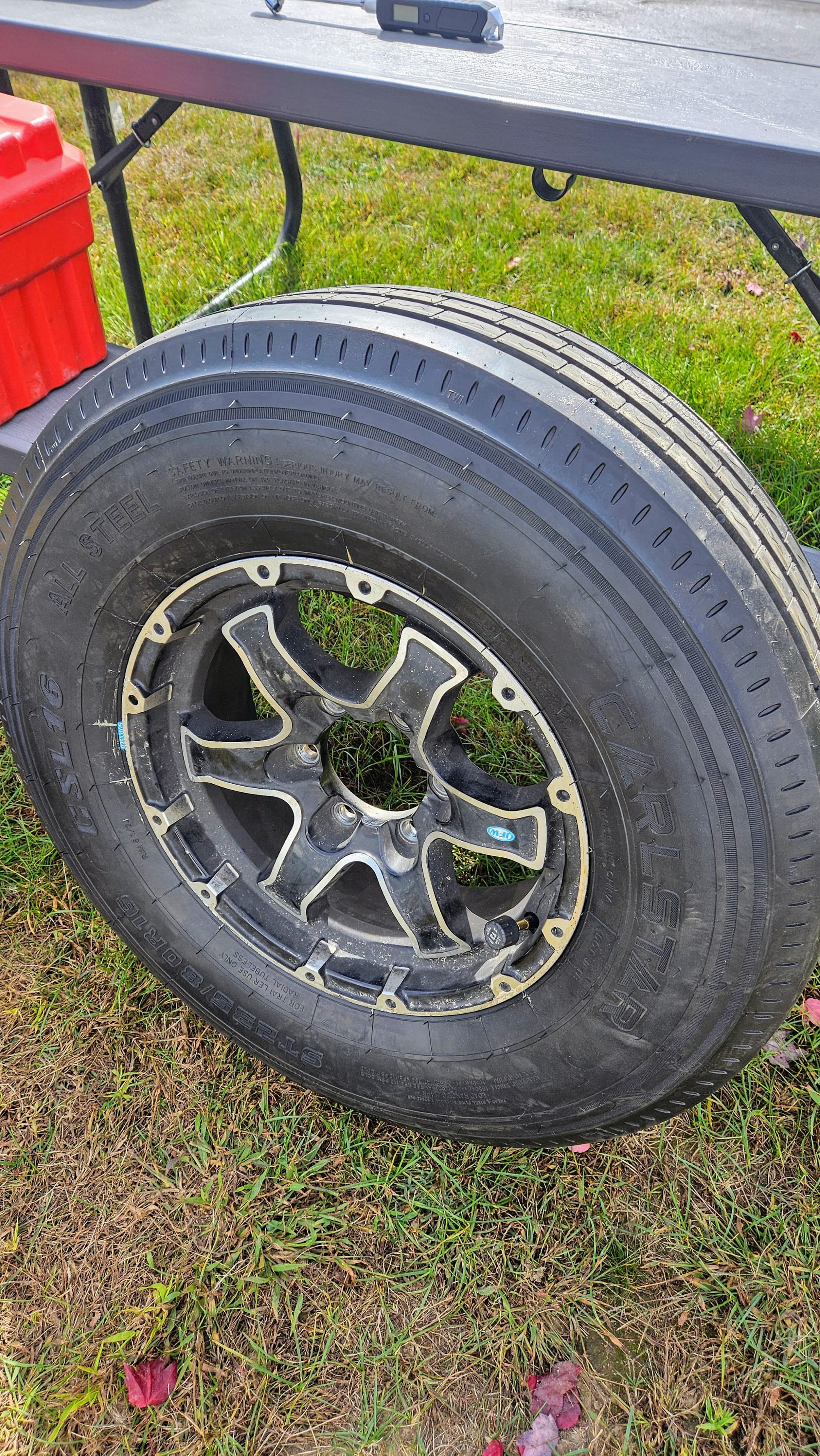
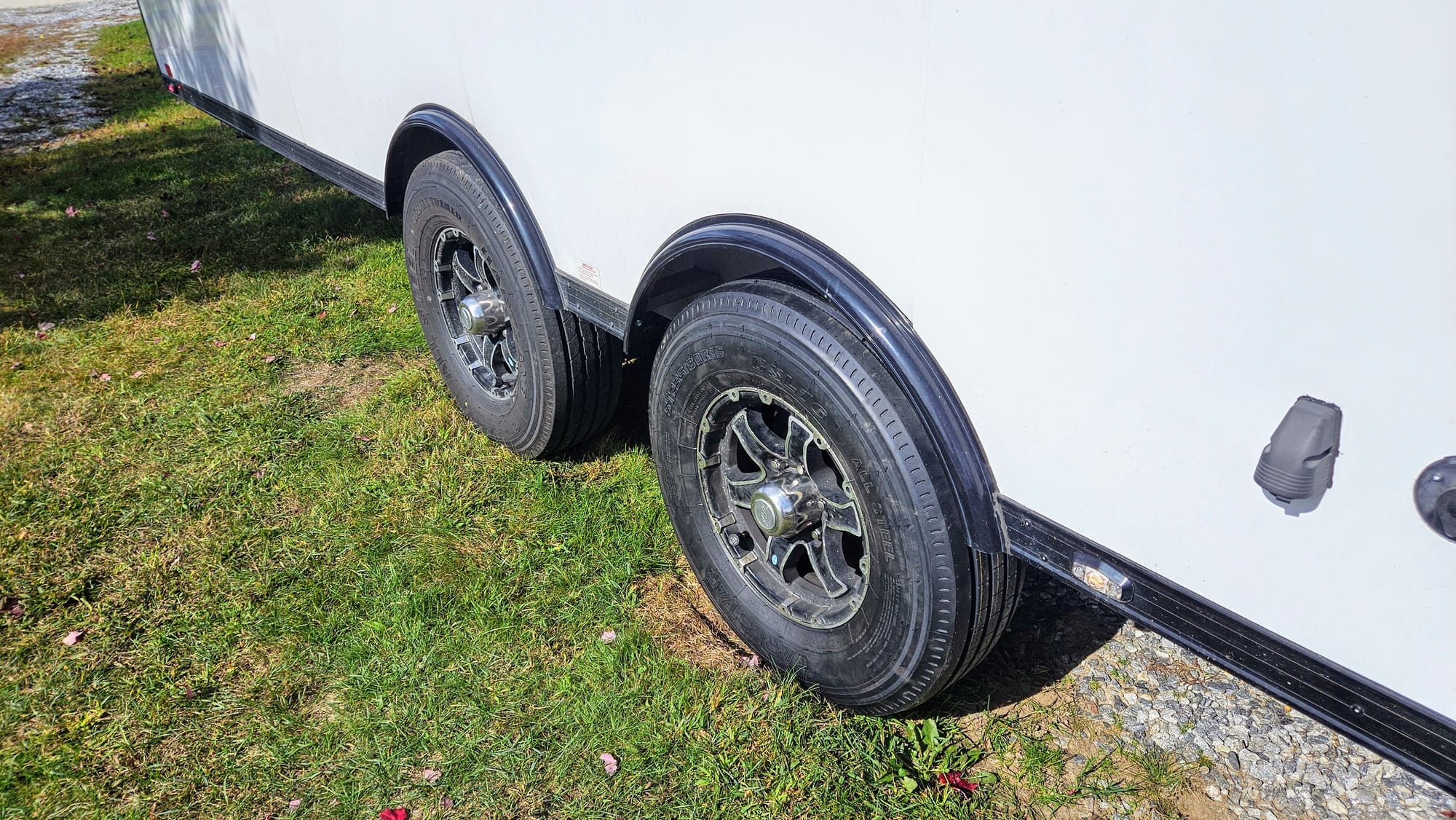
Let's look at it a little closer:
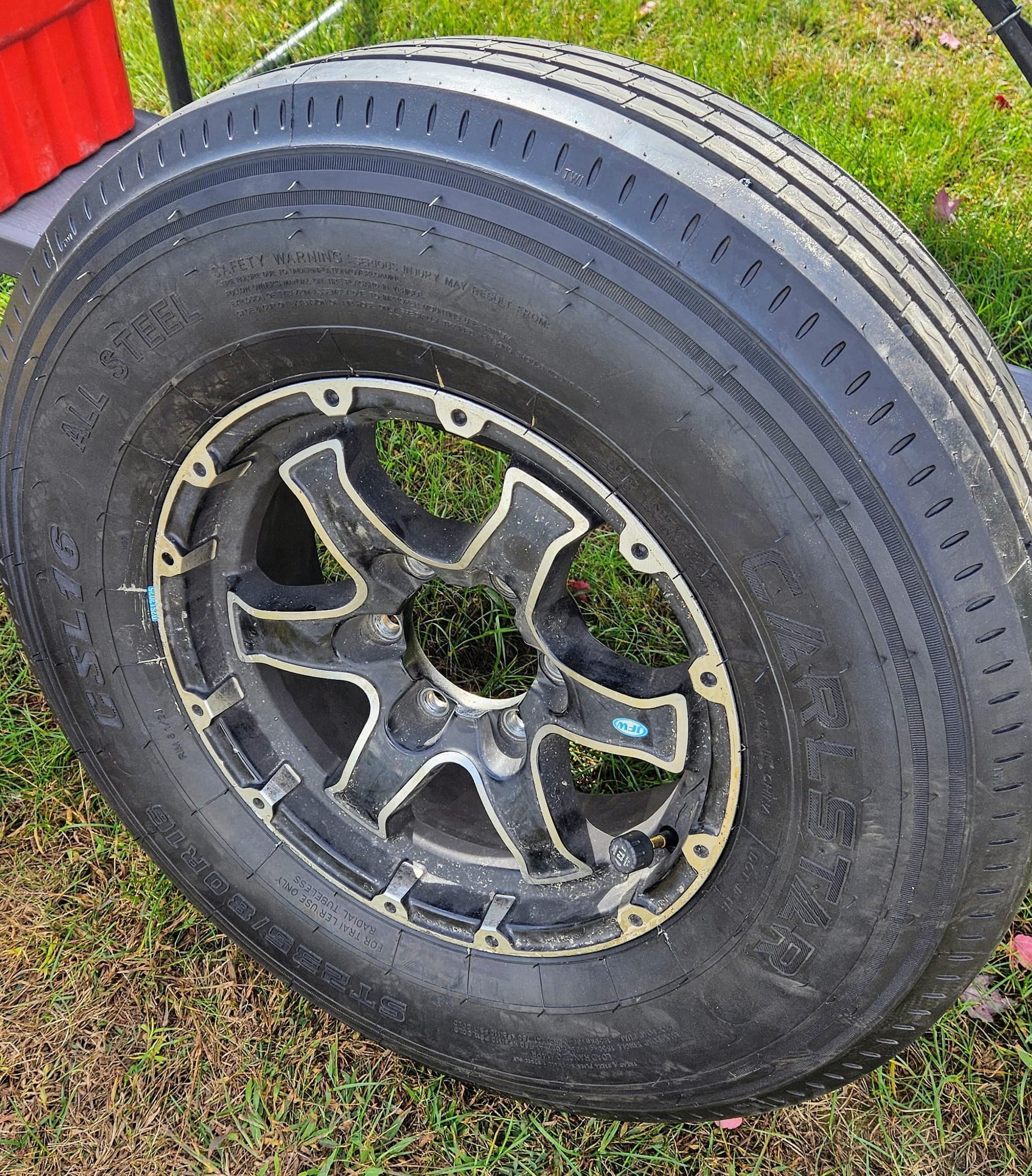
Not the Heartland, but one of the Carlstars.
We went into our Arkansas albums. This one took a while to find because we got the flat leaving Village Creek State Park, but we rode on the spare for a while because we refused to lose out on watching the total solar eclipse that following week. We delayed getting our tire replaced until after we left Crystal Springs, our eclipse-viewing site.
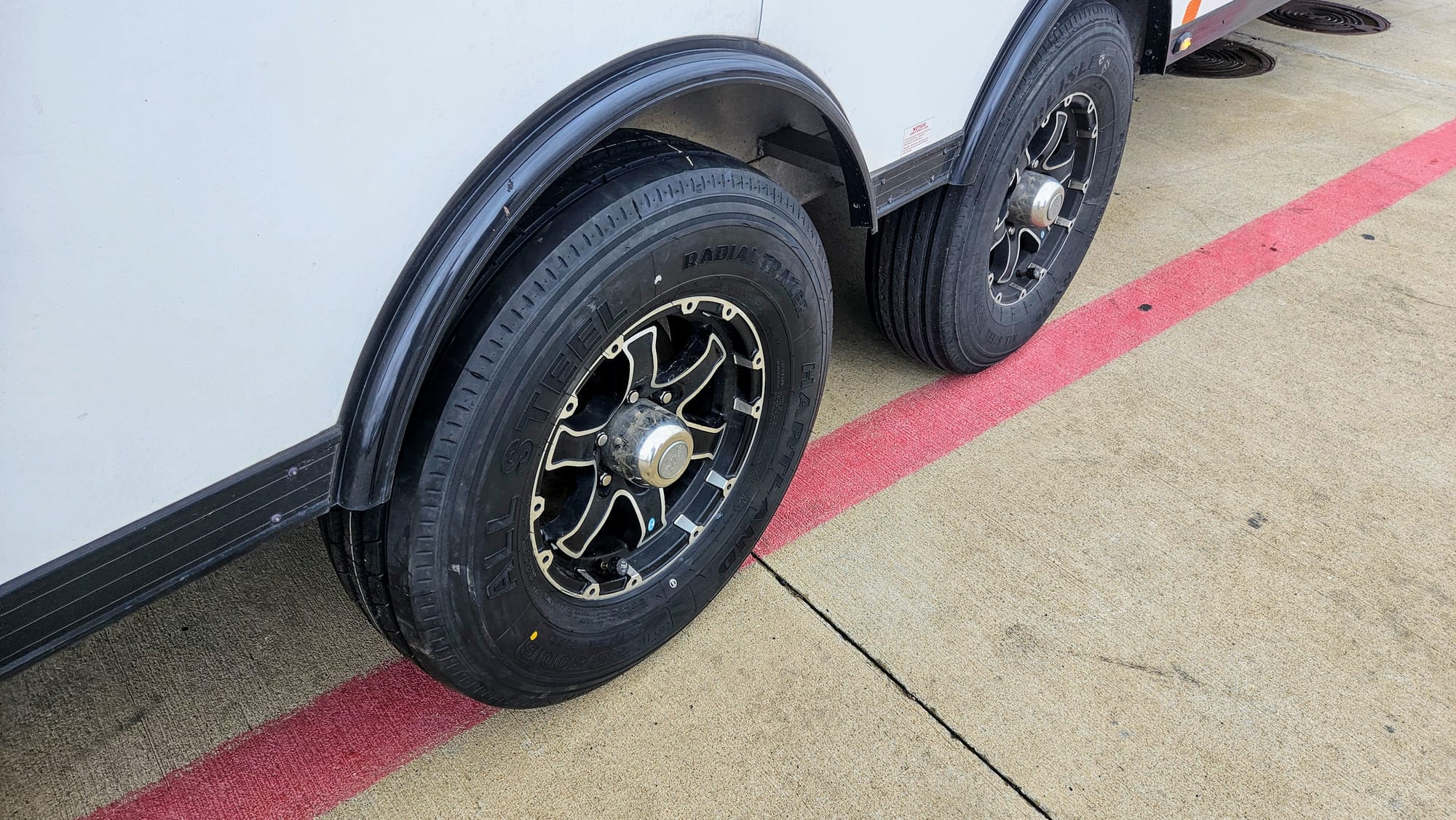
We found the picture, and there it was, the Heartland, looking much better than it had recently. (Our blog also specifically stated that we got a Heartland, but we found this later).
We never fully tracked down the origins of all 4 tires, but we got close. So let this be our best guess and our long-neglected manifest:
Heartland from Arkansas, installed April 2024 (DOT date 4923)
Carlstar from New Hampshire, installed October 2024 (DOT date 1424)
Transeagle from North Carolina, installed January 2025 (DOT date 4823)
Carlstar from Arizona, installed February 2025 (DOT date 2724)
We know the Heartland and Transeagle origins 100%. We can say with confidence that one Carlstar is from NH because they both have the DOT date on the inside wall. That only leaves our most recent tire change, in Tucson in February of last year. We're assuming the newest Carlstar came from there. Unfortunately, we have no receipts, photos, or blog posts to corroborate.
To further solidify this manifest, we thought back to when the tires have been rotated last. We haven't gotten a rotation in a while, but if we assume Trailer Parts Wholesale did it during our appointment last year, our manifest checks out. The axle guys likely switched the front and rear tires on each side to prolong their lives in case one axle was causing issues more than the other. Tire places, on the other hand, would have done a full rotation, not just a switch. A switch would in fact result in the tires being in the positions they're currently in now. Plus when we got the fat, our TPMS sensors were also switched, indicating that someone switched the tires but kept their respective sensors on.
Documenting our tire replacements is one thing we really should have been doing all along, but this whole situation made us realize that we had become lax in checking the DOT codes immediately. So many of our tire replacements were during a time of urgency, so we were not as diligent as we should be. We'll be fixing that moving forward.
Of course, we can only hope that our tire replacements will become easier to remember and document, if we can actually get to a point where they're just all replaced at once, as they start to wear. But we're reluctant to be optimistic here.
Anyway, back to the issue at hand: figuring out if the Heartland could be revived. Once back on the trailer, we did a bead test by spraying soapy water around the rim and checking for any bubbles. We saw no leaks. After a few minutes, we manually checked the tire pressure under load. It had barely budged. More evidence that we're not dealing with anything more than the faulty valve stem.
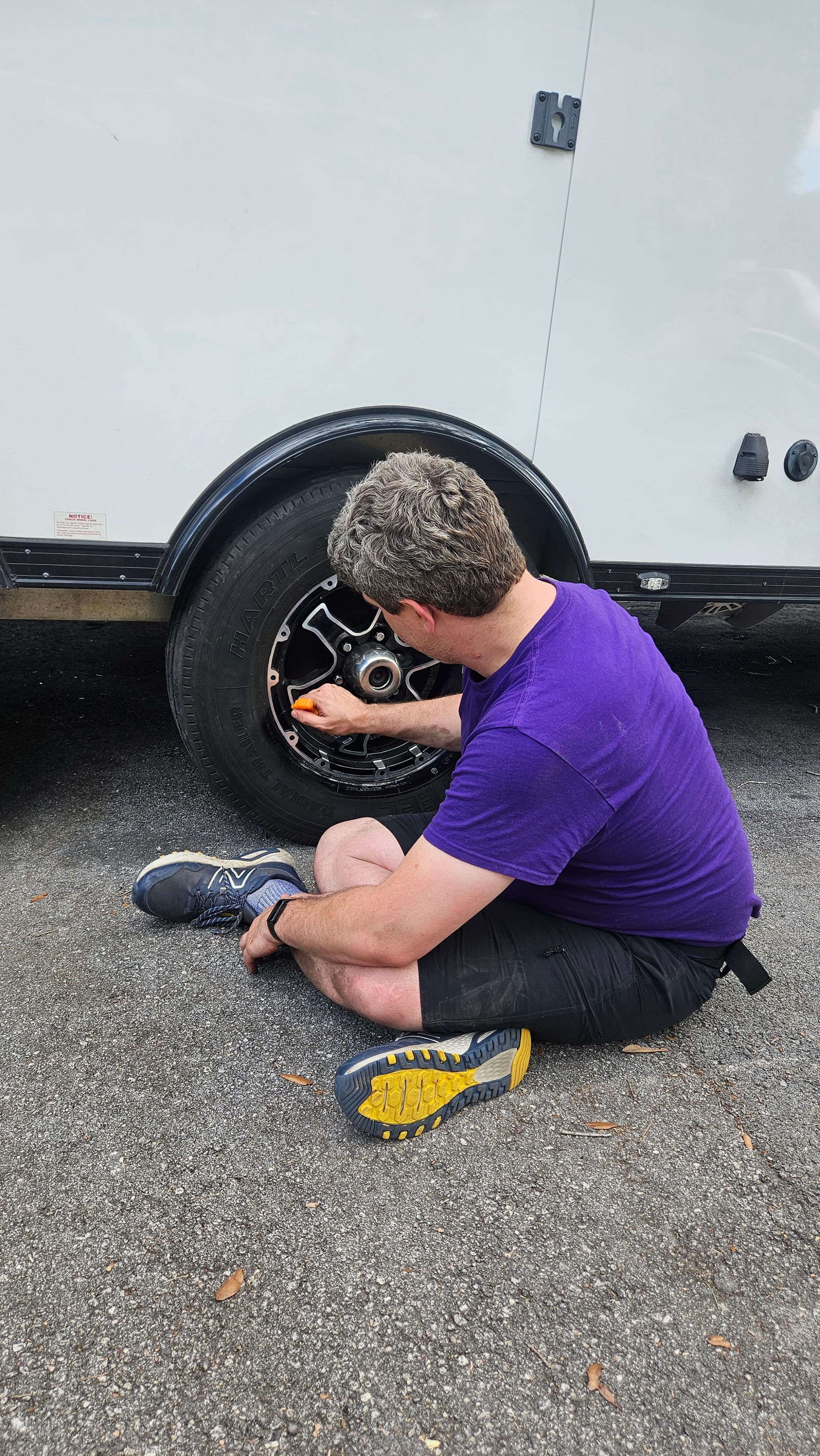
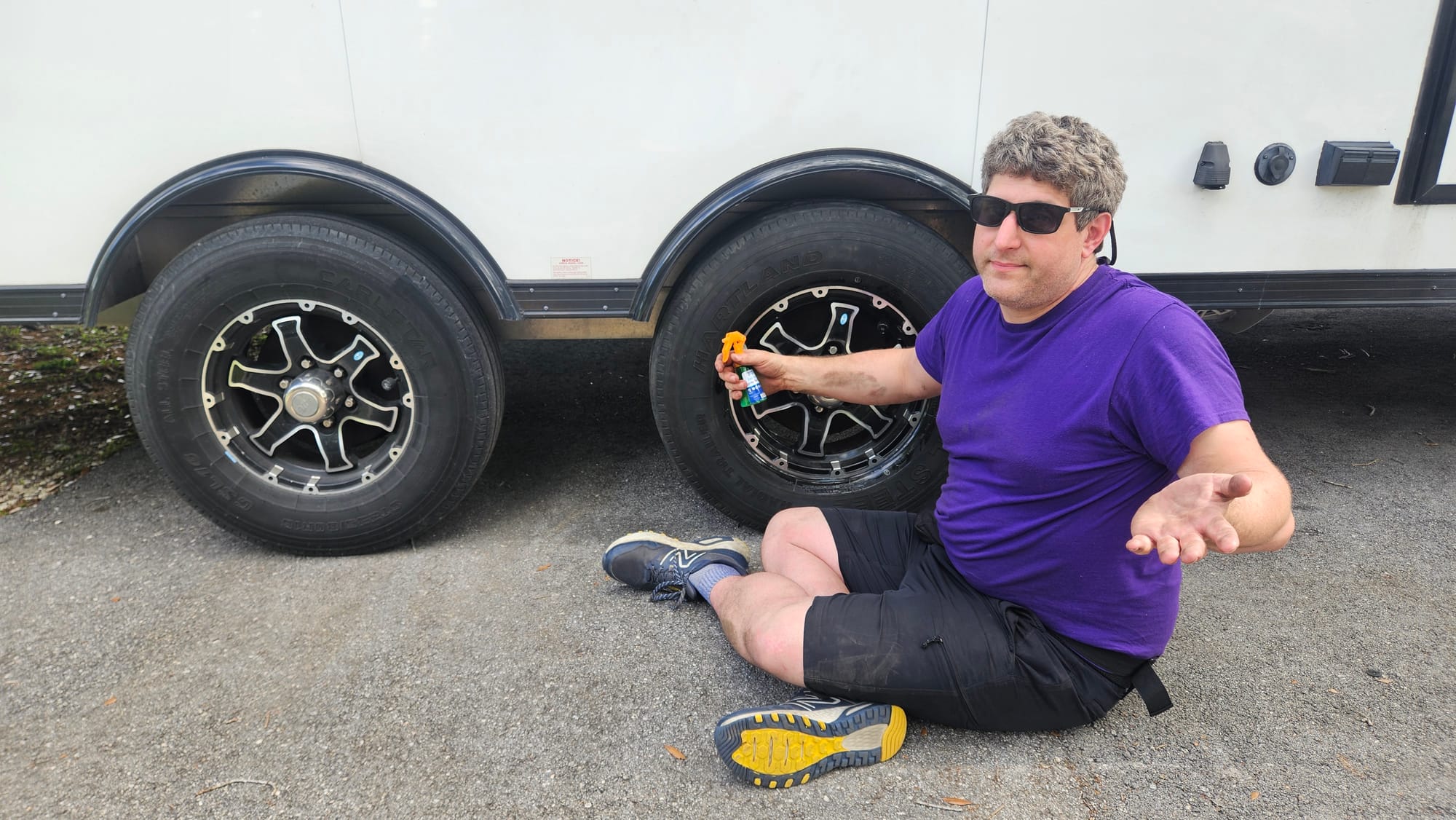
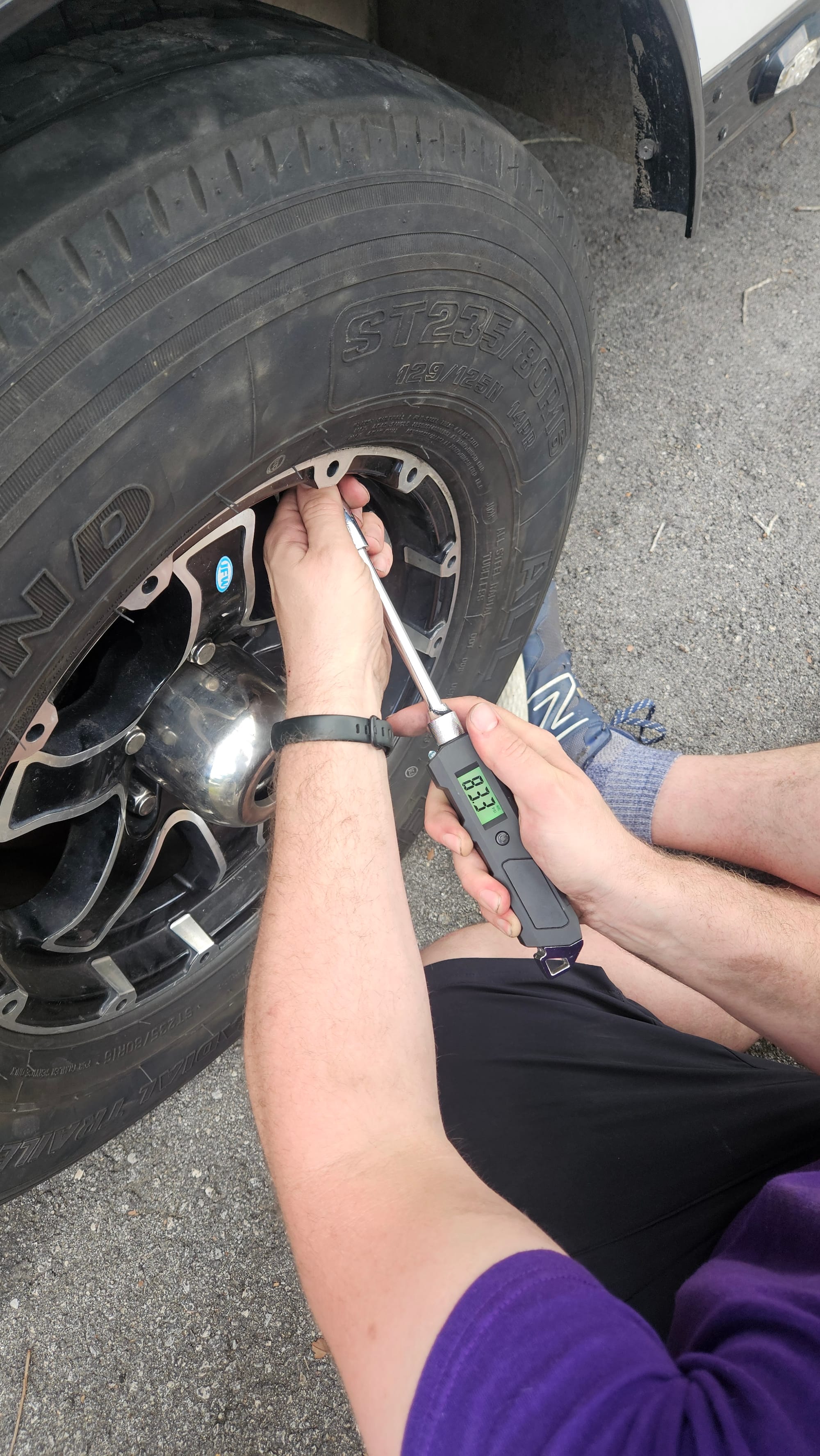
So far, so good in Phase 2. We'd watch the tire over the next couple of days to see if it holds air. If it does, we'd decide if we trust riding on it for a while. If it doesn't, we'd put the spare back on and head to the nearest Discount Tire.
But not so fast! The RV life domino effect struck again as we were putting the Heartland back on. One of our lug nuts stripped!
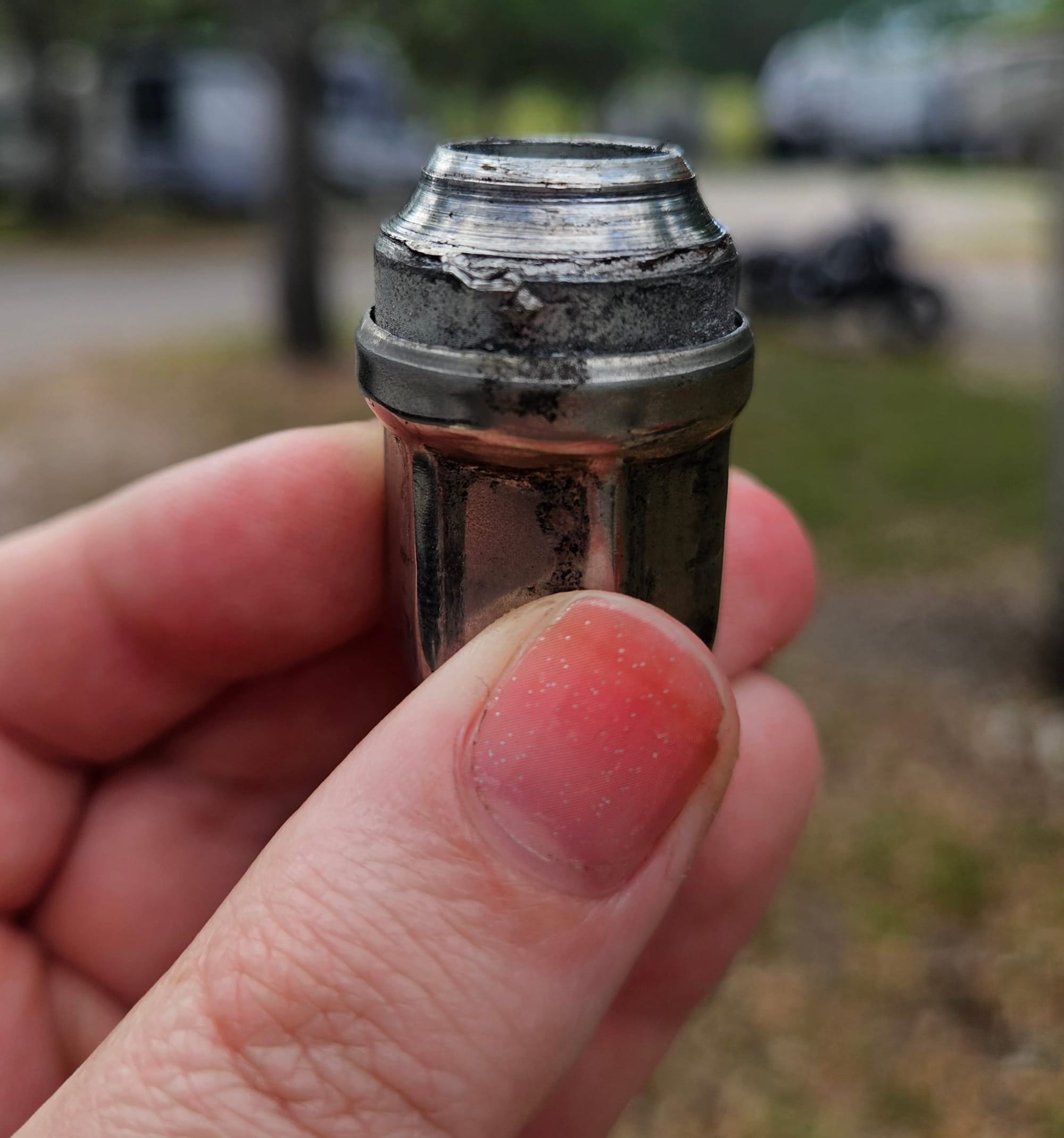
Props to us for jumping on our repairs upon arrival to our campsite. If we had waited until departure, we would have been running to Napa Auto Parts to get a lug nut before check-out time. We saved ourselves a lot of stress.
Phase 3: Touch and go
Our campsite may have been long enough to stay hitched and change our tire, but it was on a big slope. We wouldn't be able to truly observe the tire until we were on more level ground. The downward slope made the front tires look flatter, but this was because more pressure was on them. In reality, they were holding air just fine.
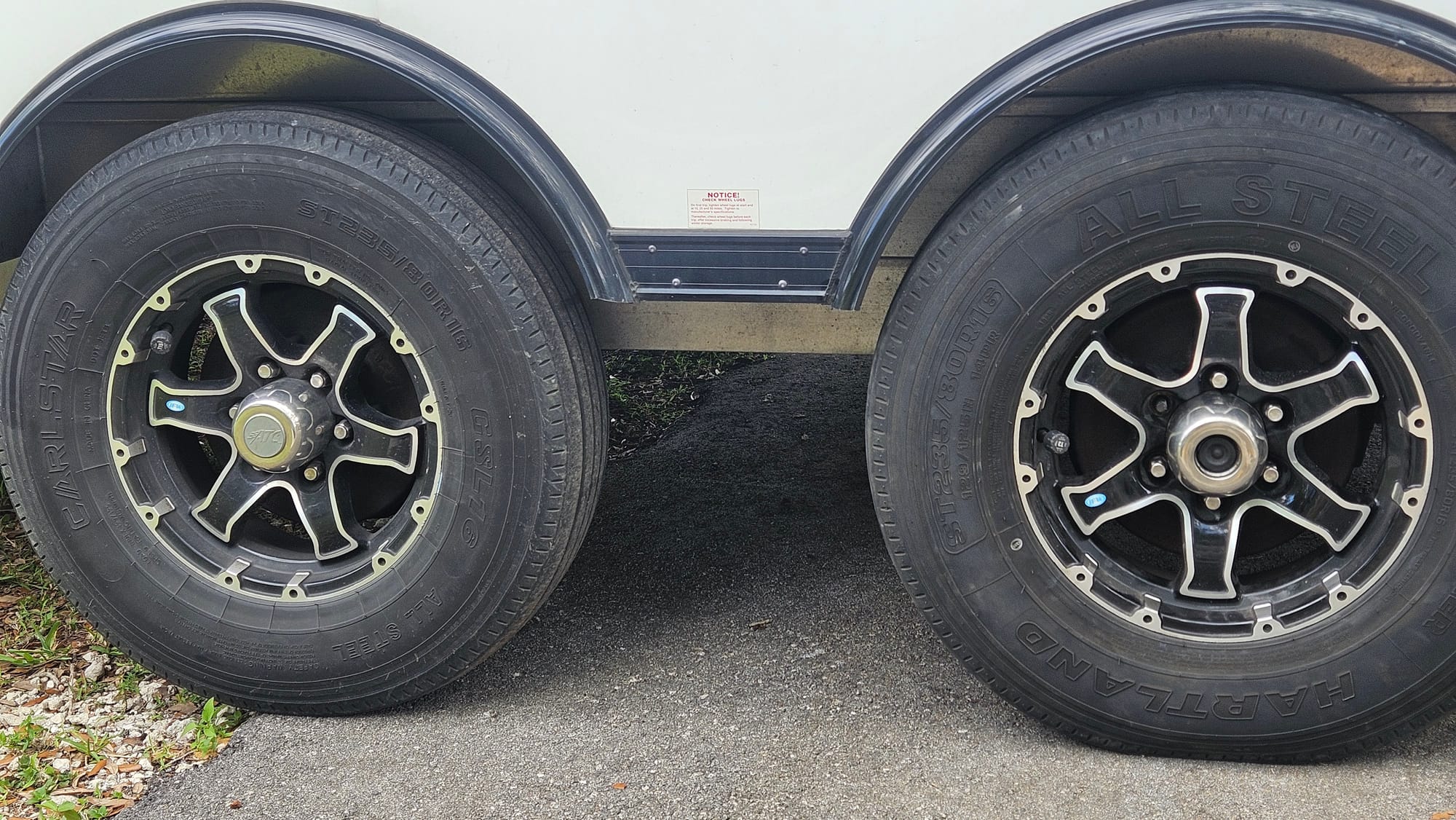
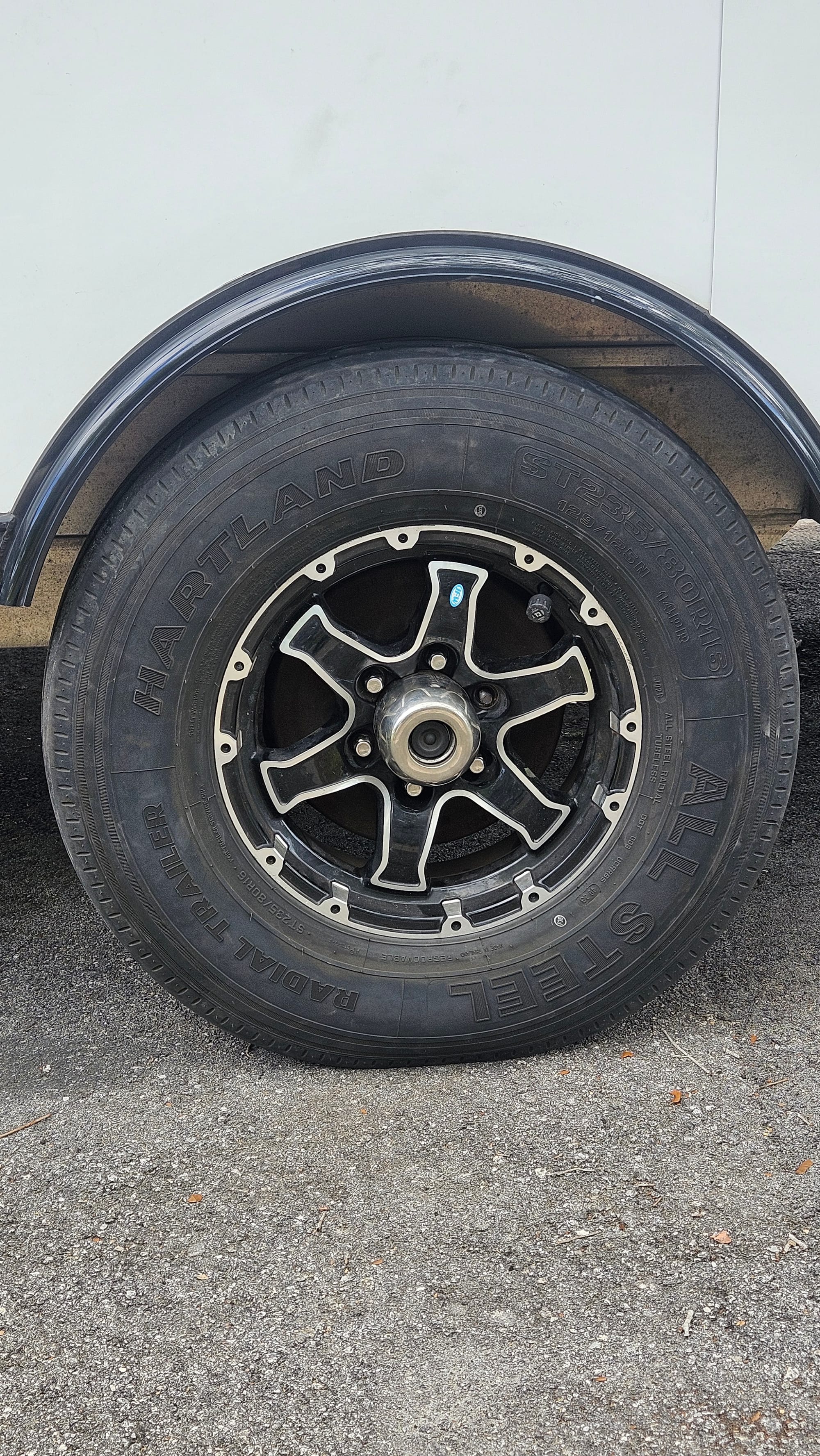
During our few days stationary, we replaced the lug nut and made a plan for our departure. The plan was, don't make a plan. All we knew was that we wanted to check the tire pressures manually before leaving, torque all the lug nuts, and then try to find a level plane to stop on before leaving the campground.
Easier said than done. Not only were we dealing with sloped terrain, when we're hitched, we're automatically putting more weight on the front of our trailer. This is where the heavier areas are, like our bedroom and kitchen. We tried to get the trailer as level as possible, even using one of the park's giant speed bumps to assist, but we still couldn't quite get there.
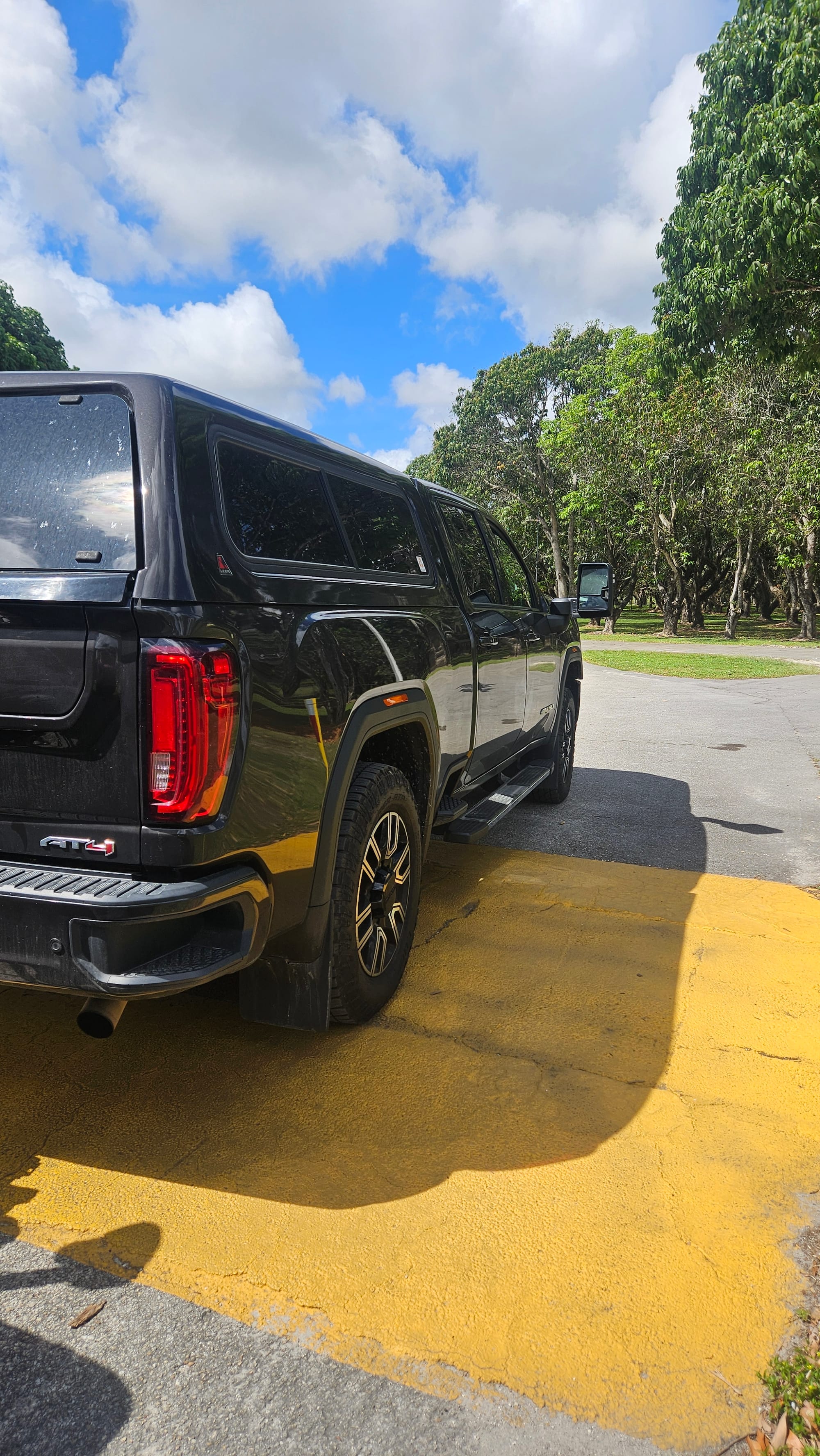
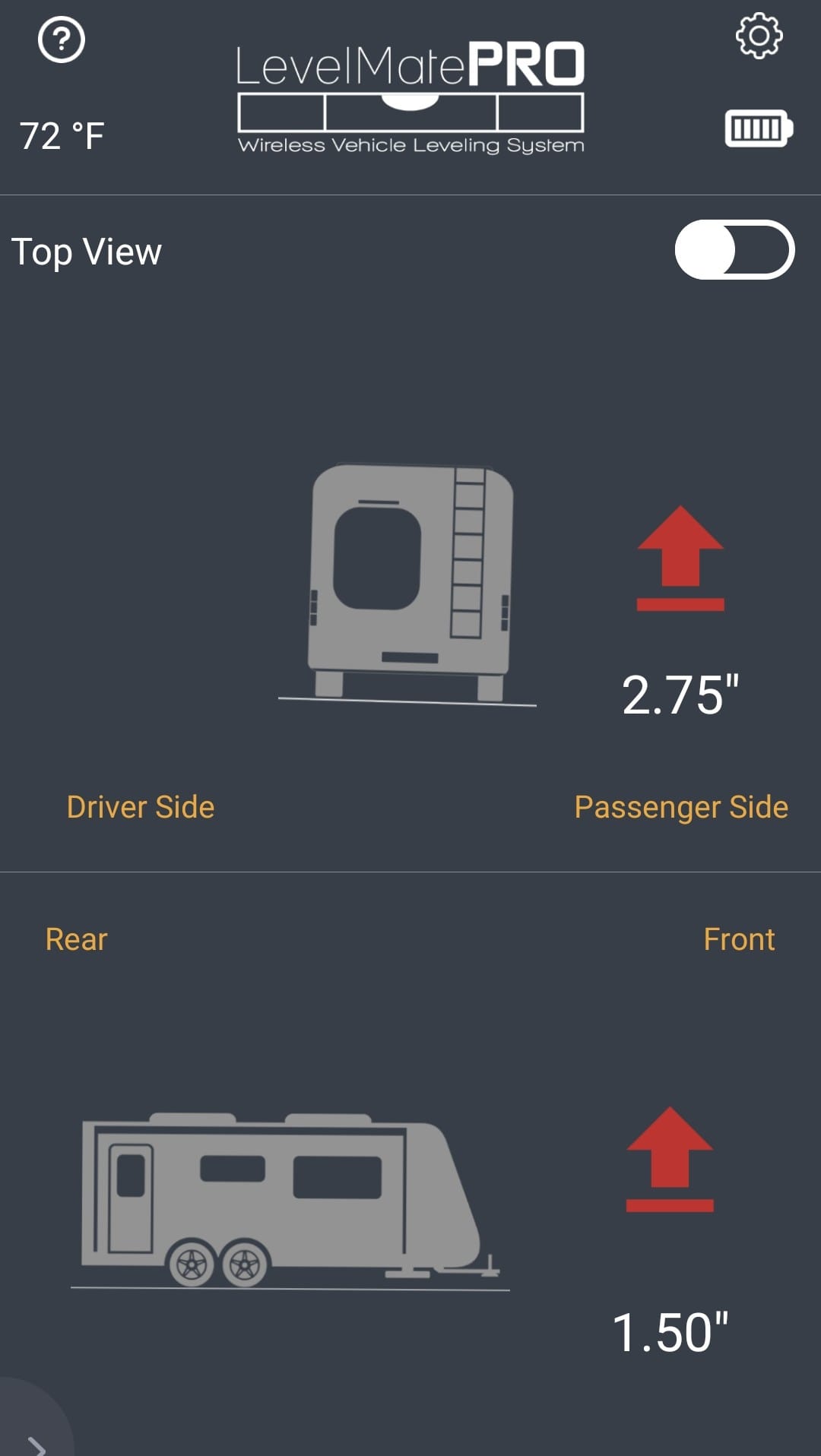
That didn't stop Nicole from taking pictures from all angles, though.
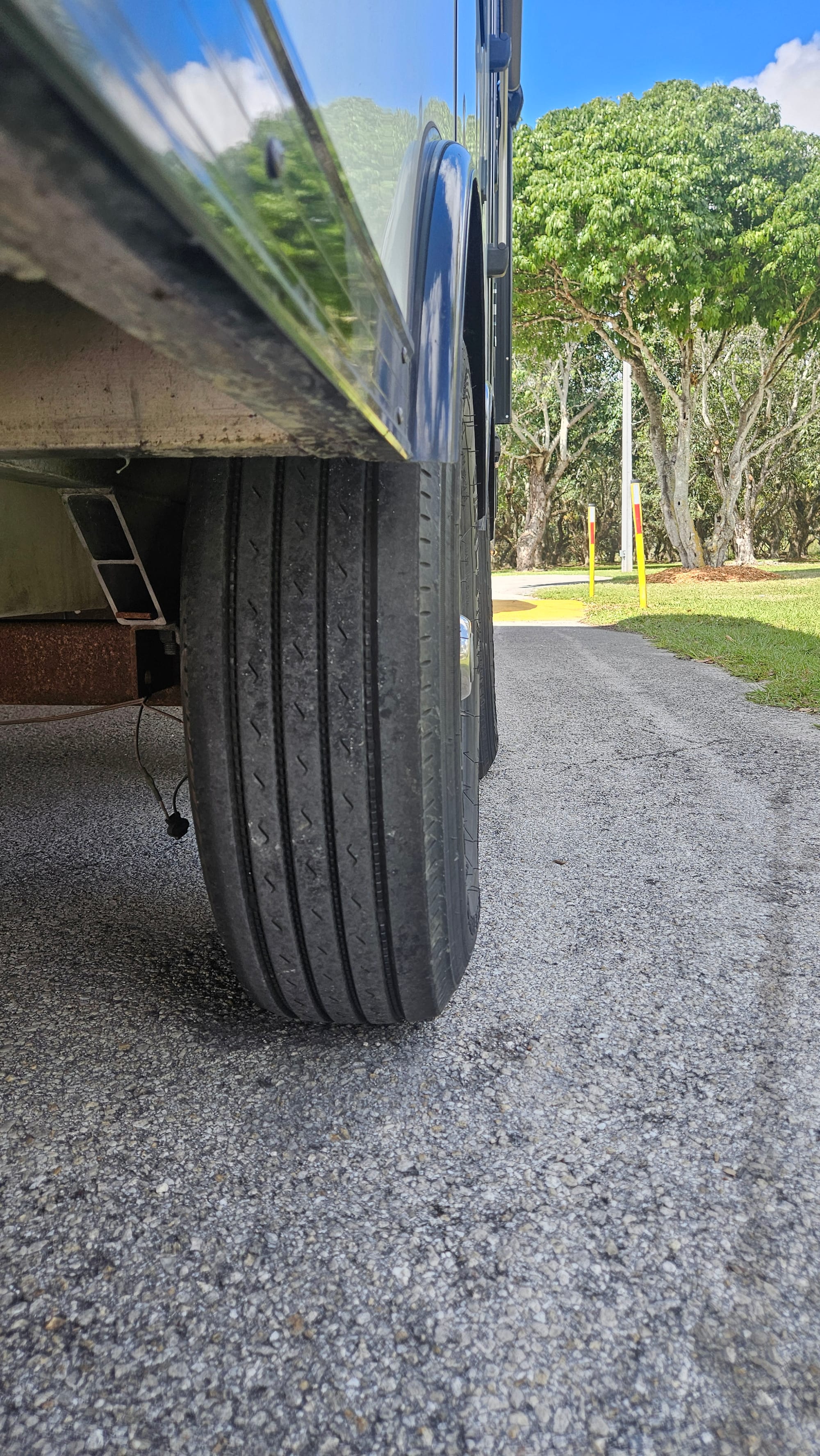
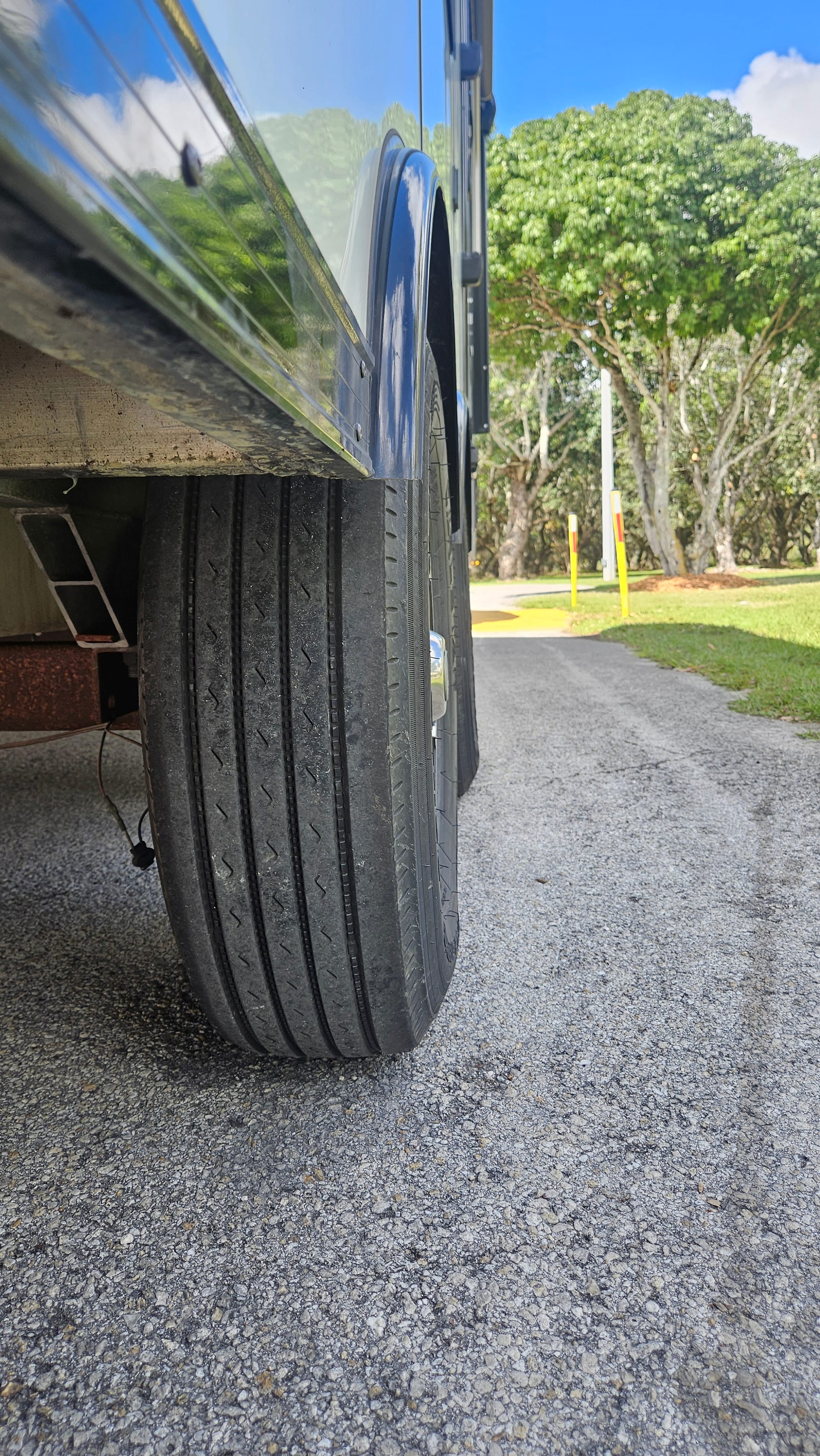
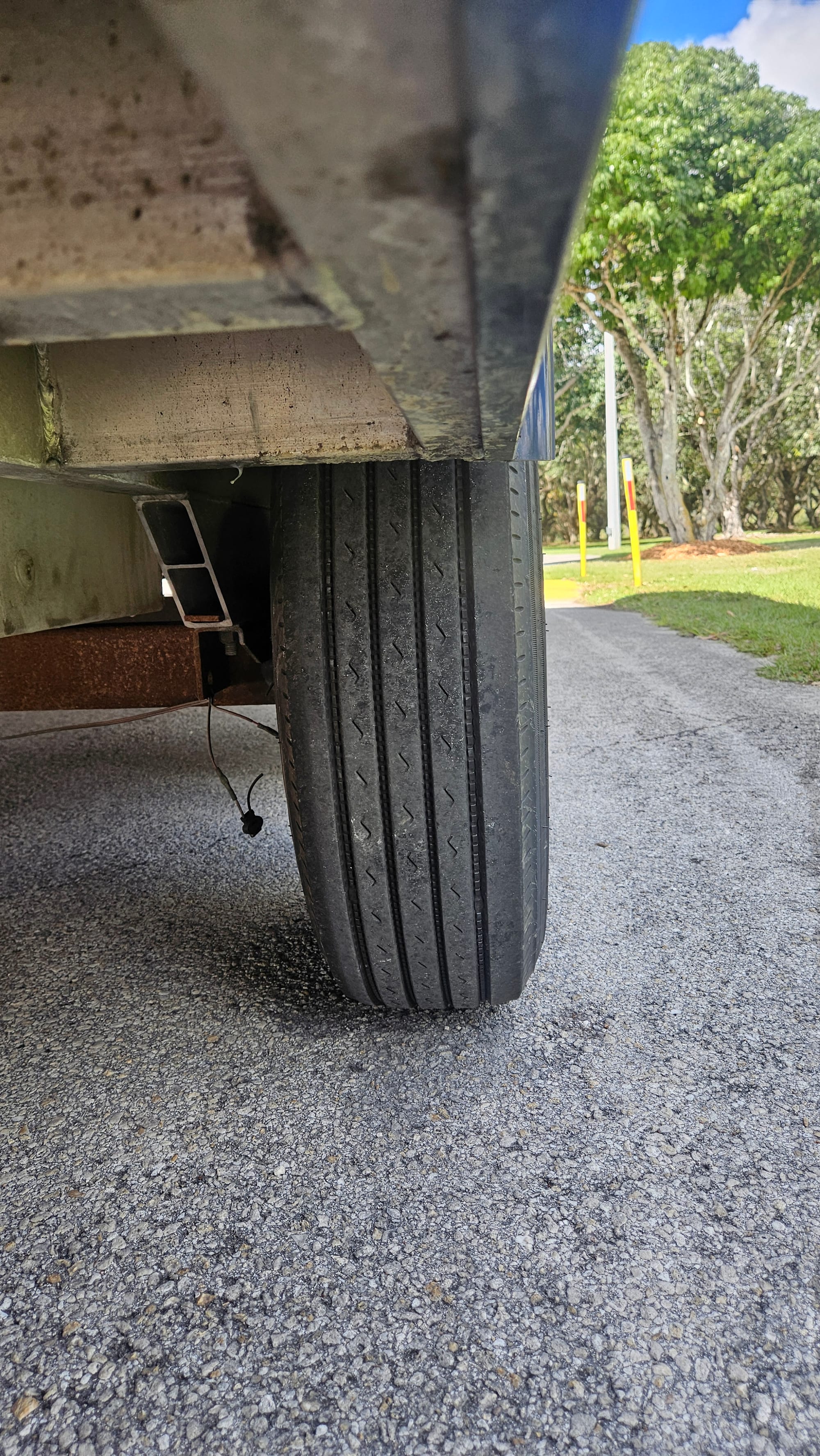
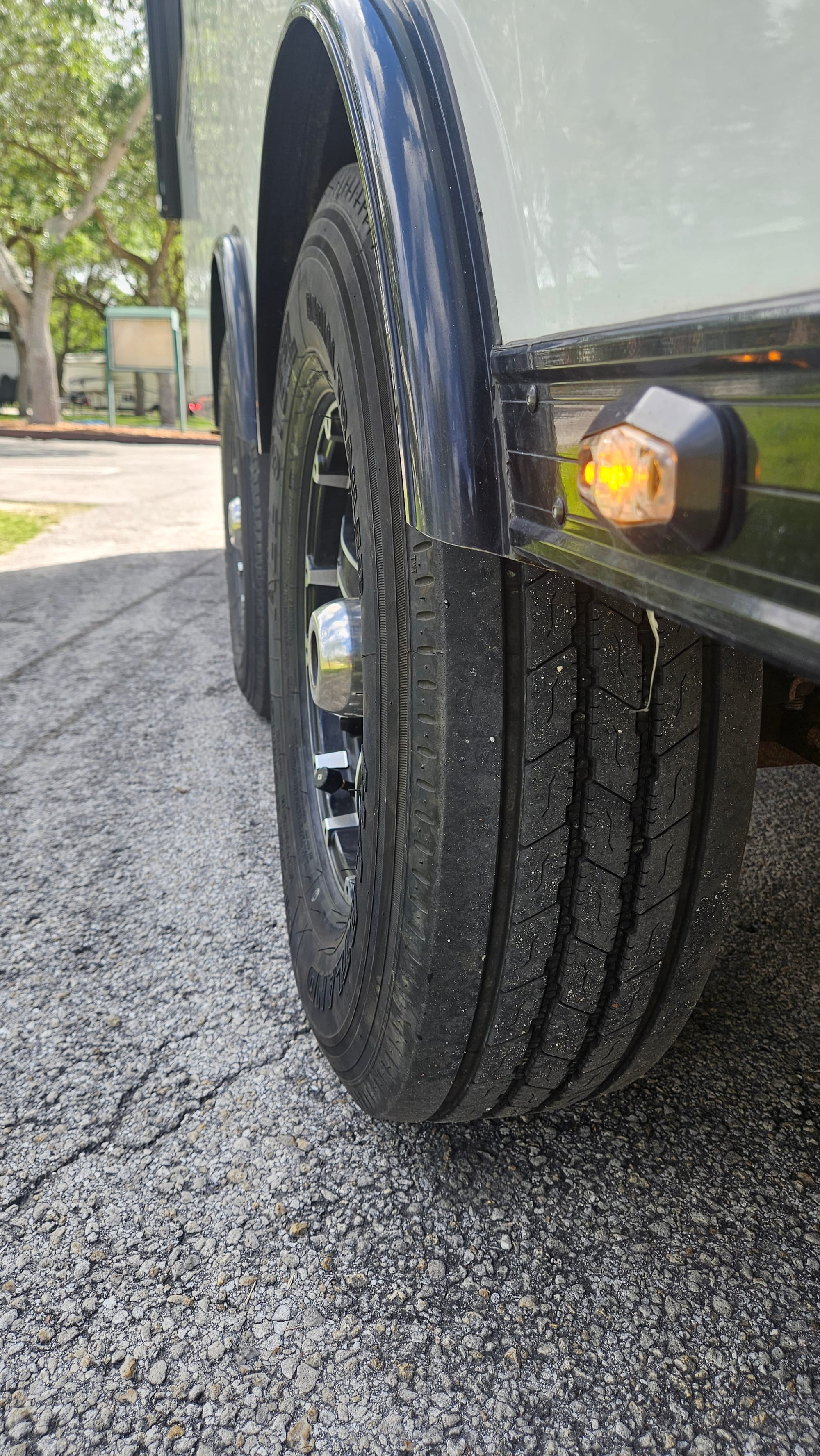
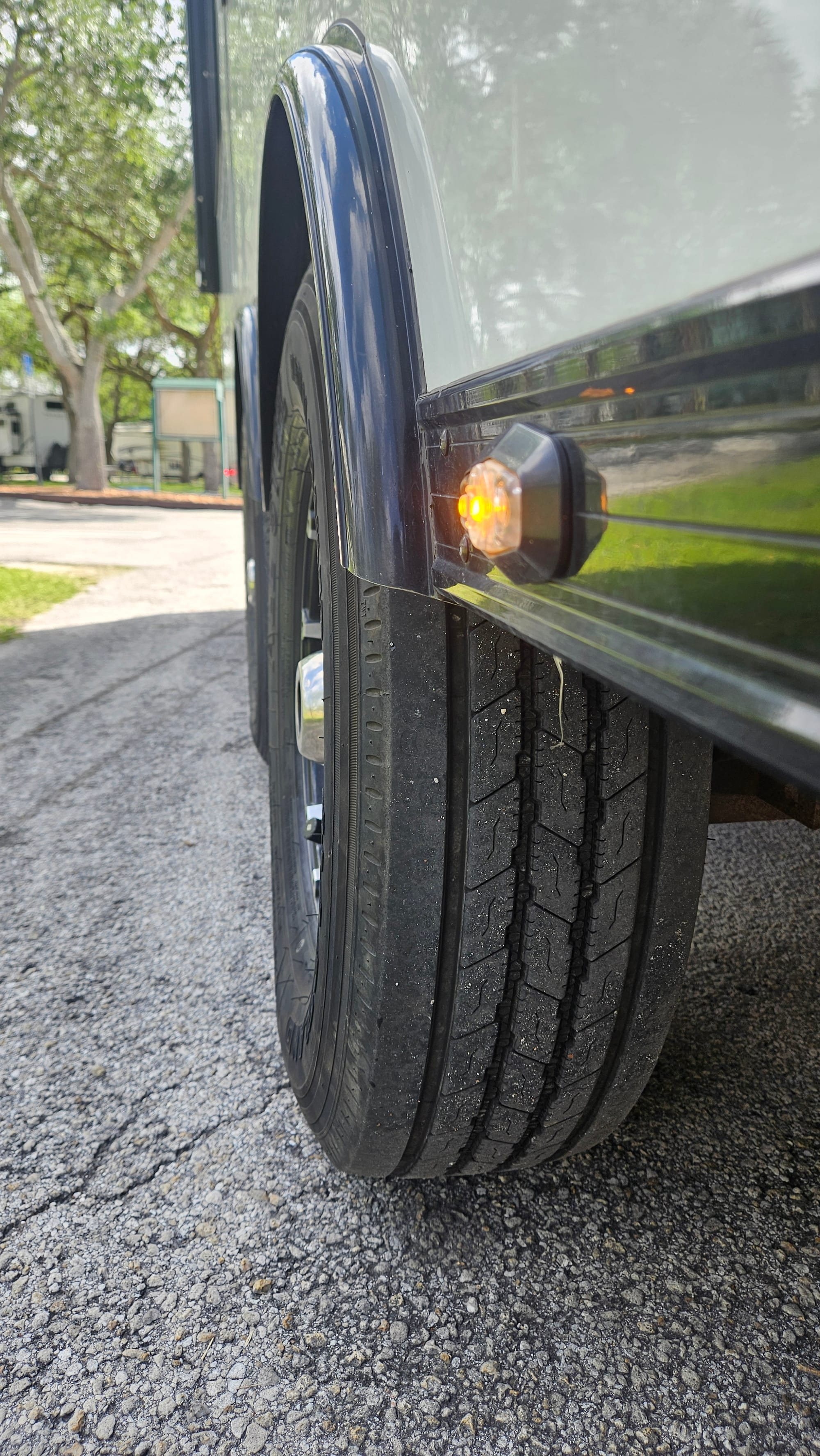
Yes, there are a lot of things hanging near the tires. No, you don't need to worry about them.
It's tough to decide to ride on a tire that we don't trust, but we weren't going to get anywhere – literally or figuratively – just by staying in the campground. We headed back to the FL Turnpike with no destination. We decided to just drive and make stops every hour or so along the way.
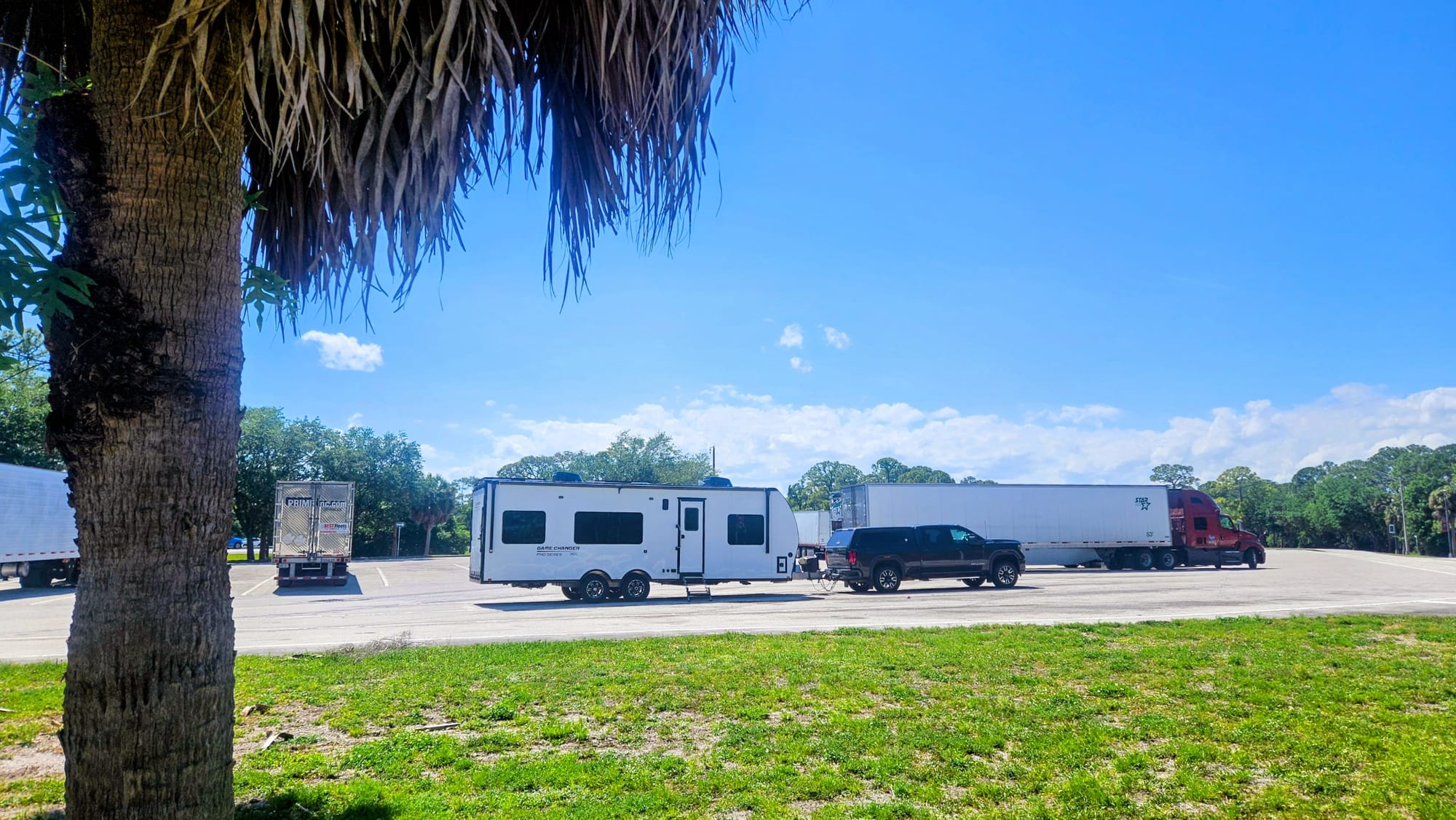
We drove way further than we expected – 330 miles! The tire held air and seemed to act exactly how it's supposed to. Then, when we arrived to our site for the night, we found what we had been looking for all along: a level plane. The next day, we jumped right back into observing the tires and comparing their positioning.
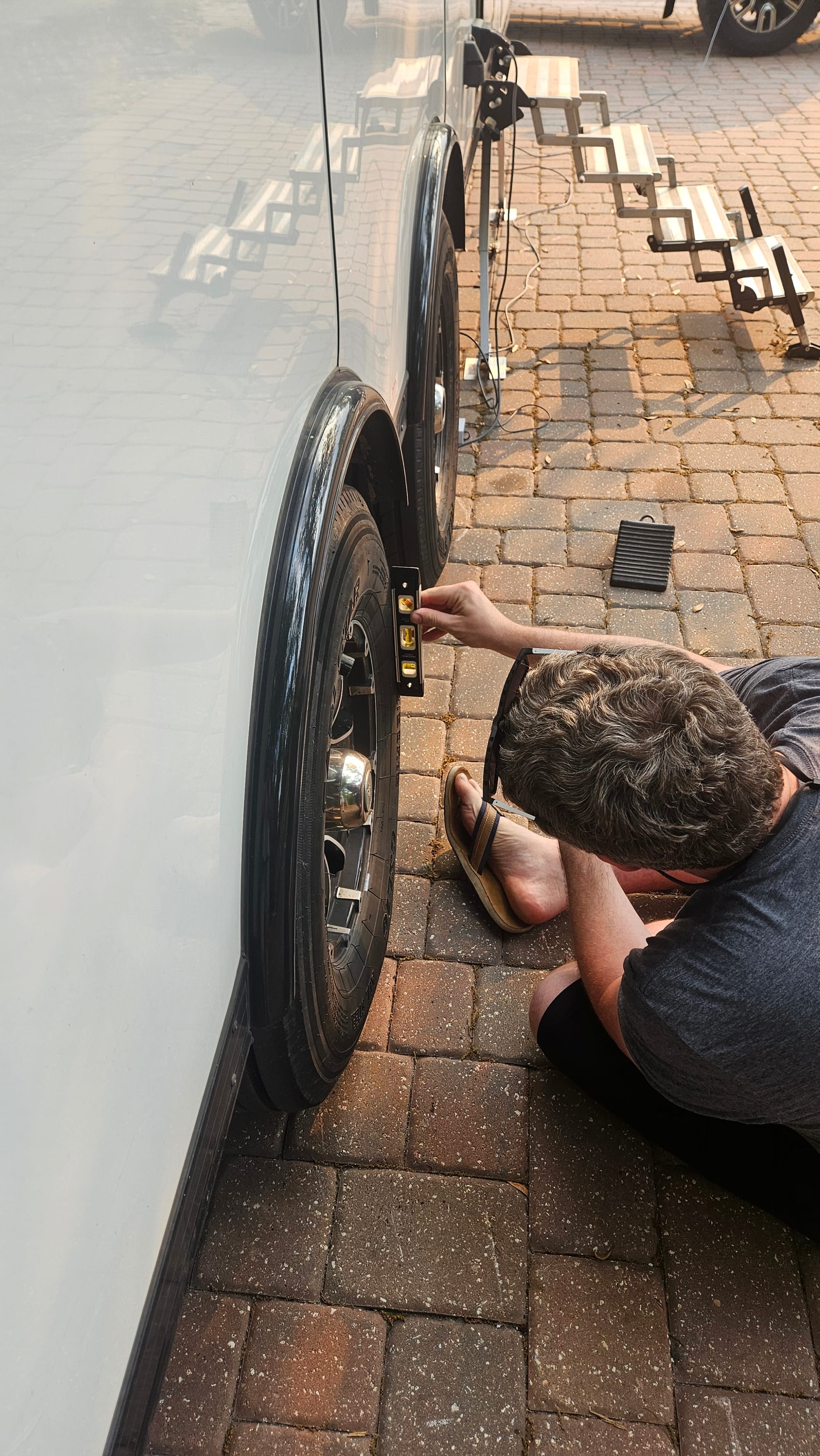
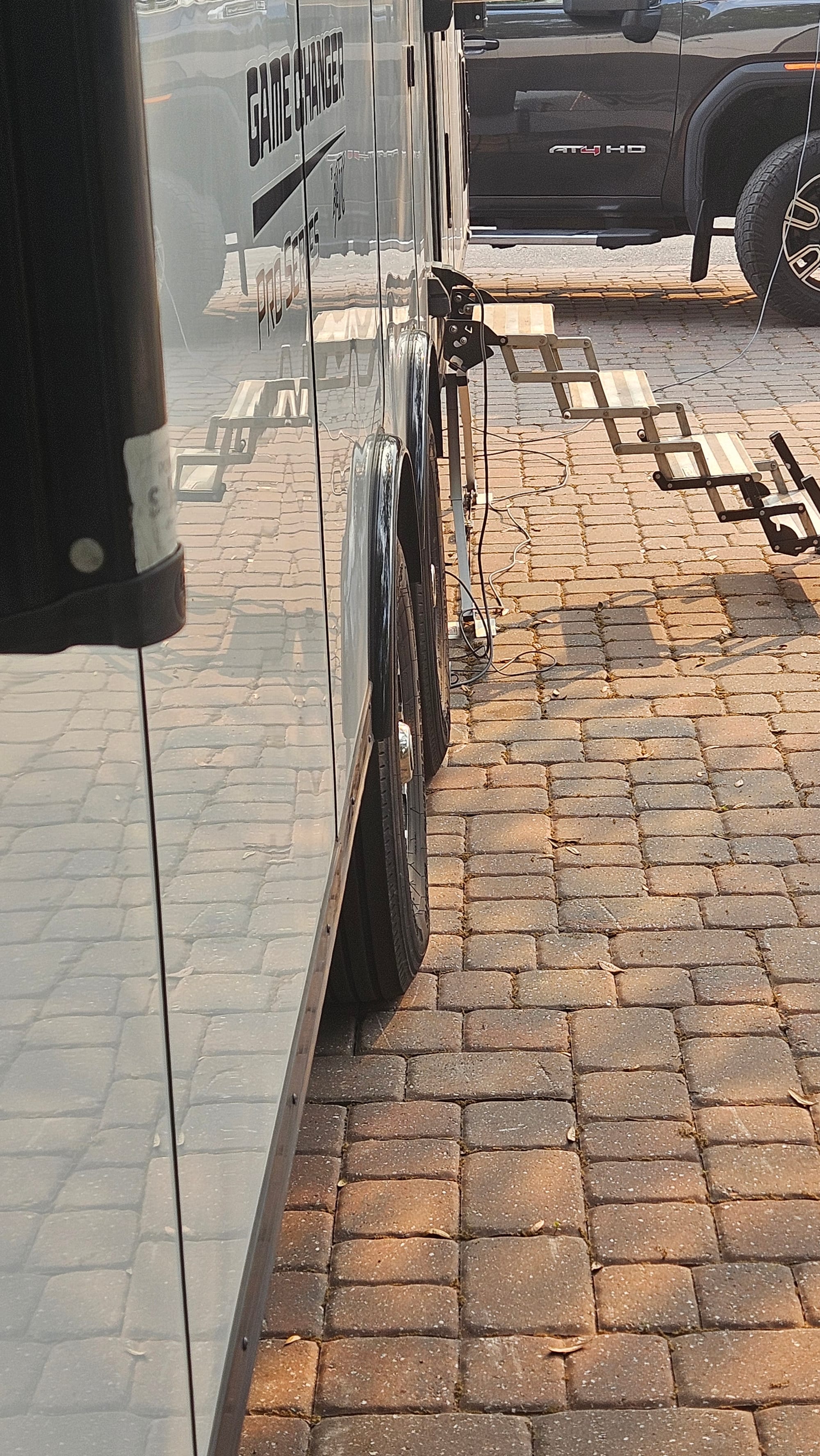
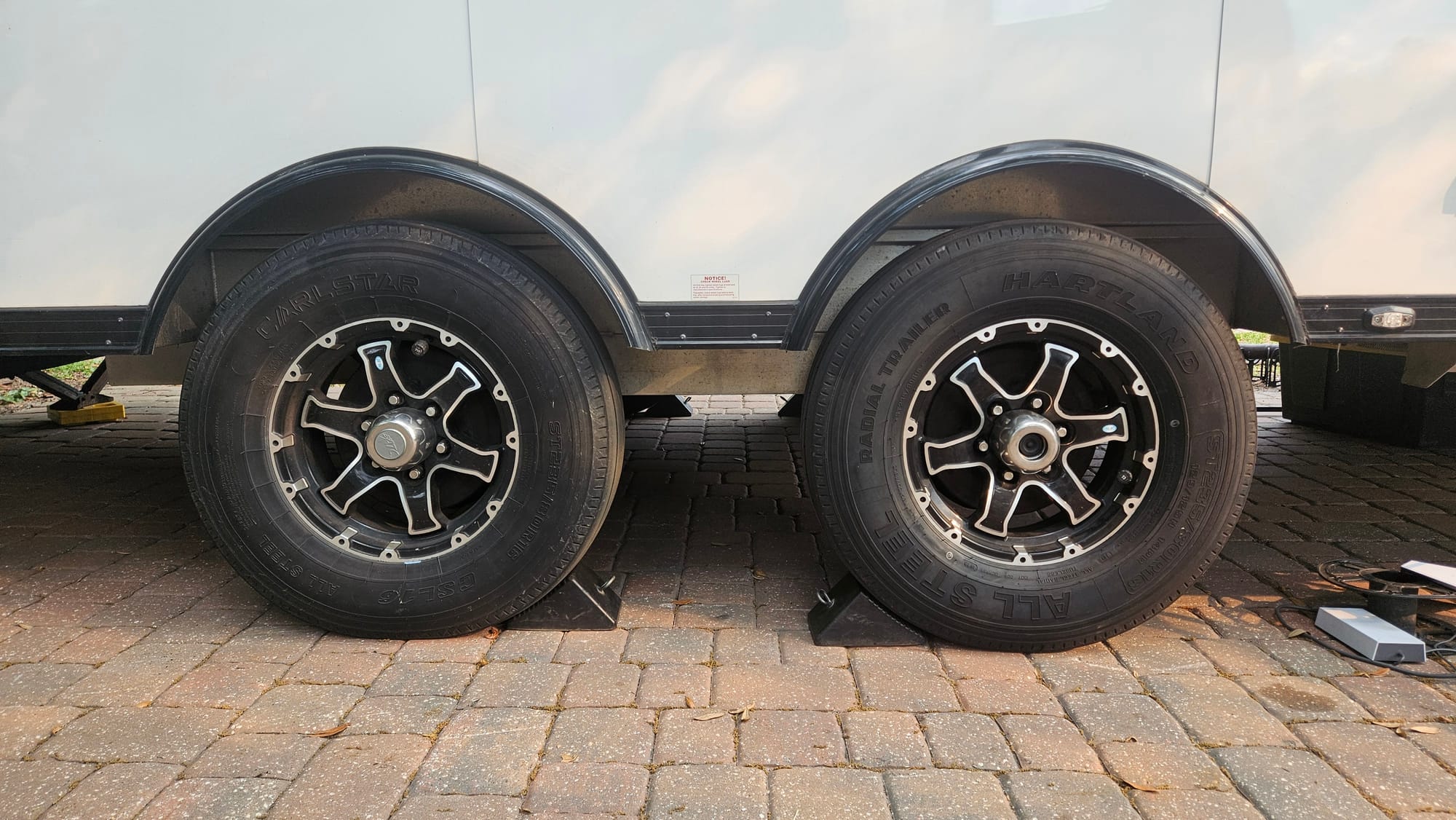
Yes, that's Anthony even using a level to look at our tire angles. We really ended up grasping at straws! But on the more level ground, it was very hard to see an obvious difference in that specific tire. Yes, the tires sit at slightly different angles, but this can be explained by a multitude of reasons that are perfectly normal and safe.
The verdict (for now):
We're taking the win that our tire held air for 330 miles, but of course we'll continue wondering if the leaky valve stem was part of a bigger problem. We might get our answer soon, or we might not get it for thousands of miles, or ever. Human observation counts, but it's not more important than the facts: The valve stem replacement worked; there's been no uneven wear; the trailer is towing great. We just need to stay diligent, and if anything changes, we'll be ready.