
Inverter goes up in smoke!

So far, season 5 has been a tough year. We seem to be on the dark side of cosmic intervention, a road we wish we could get off.
First, we got stranded at our home-base in MA during their snowiest winter in over a decade.
Then we finally escaped, but drove into a whole other weather problem – severe thunderstorms and a tornado watch.
We gritted through lots of stressful drives over bridges and through tunnels, and then ended up in a campsite that was being excavated.
We finally made it to FL...but ended up with a flat tire.
Then 2 days later, we got another flat tire.
We tried to fit in moments of reprieve by planning visits to Key West and St. Augustine, but those destinations could only help so much. We were stressed, frustrated, and patiently waiting for our time of ease.
That's why after leaving St. Augustine, all we wanted was a campsite with no distractions. We had work and chores piling up, plus we were exhausted from constant triaging of RV problems, then trying to counter those problems with fun excursions. We needed to regroup. Where do we go for regrouping stops? KOA. We booked 4 nights at the KOA right off I-95 in Yemassee, SC – a campground where most people are passing through on their travels and just need a convenient place rest. Not much is around except for the interstate and some gas stations. It's not just our regrouping stop. It's everyone's.
We had a smooth drive day – something we don't take for granted these days. We left FL and entered GA, where we had an extra long lunch break at Buc-ee's. Then we got to our campsite in the early evening, with time to spare before sunset. Things were looking good. Nicole began prepping her next few days of work, and I jumped on a meeting with a colleague. It was business as usual...until things took a sudden turn.
I was in the main part of the RV and noticed that the 120V electricity cut out. Nicole was in the bedroom, and unbeknownst to me, noticed a strong electrical burning smell at the same time. She came out wondering what was going on, and it only took a few seconds for us to put our observations together: Something overheated in the storage bay enough for us to lose power. That was not good.
We've had issues with overheating in our storage bay in the past. Soon after we got our solar installation in 2023, our new inverter started overheating when we camped in hot temperatures. That summer, we were camping in horrendous heat in Wyoming and got error messages that our batteries and inverter were overheating. Then at the end of that summer, all our batteries had a cascading failure while we were boondocking, sending our rig into a complete blackout as a result.
The storage bay isn't the best place for us to keep our electric equipment, but it's basically all we've got. We've done some things to help us keep the storage bay at a safe temperature, including getting a ventilation fan installed, which has helped a lot.
All those previous issues happened on really hot days. The ambient temperature in the storage bay was always the culprit. If the weather was hot, the storage bay was hotter. But now that we have the fan, plus we prop the bay door open when it gets hot, we haven't had the same issues. This time was different. Temperatures were only in the 60s and dropping. The sun was setting. Despite this, we still had our vent fan running. This wasn't just a typical "it got too hot so let's let things rest" scenario. We had the burning smell to prove it.
We opened the storage bay and encountered heat that was at least 30 degrees higher than the outside temperature. The smell was overwhelming. The inverter was too hot to touch, but as soon as it cooled a little, we pulled off the front panel to see if we could find anywhere that looked burned or melted. Everything looked status quo.
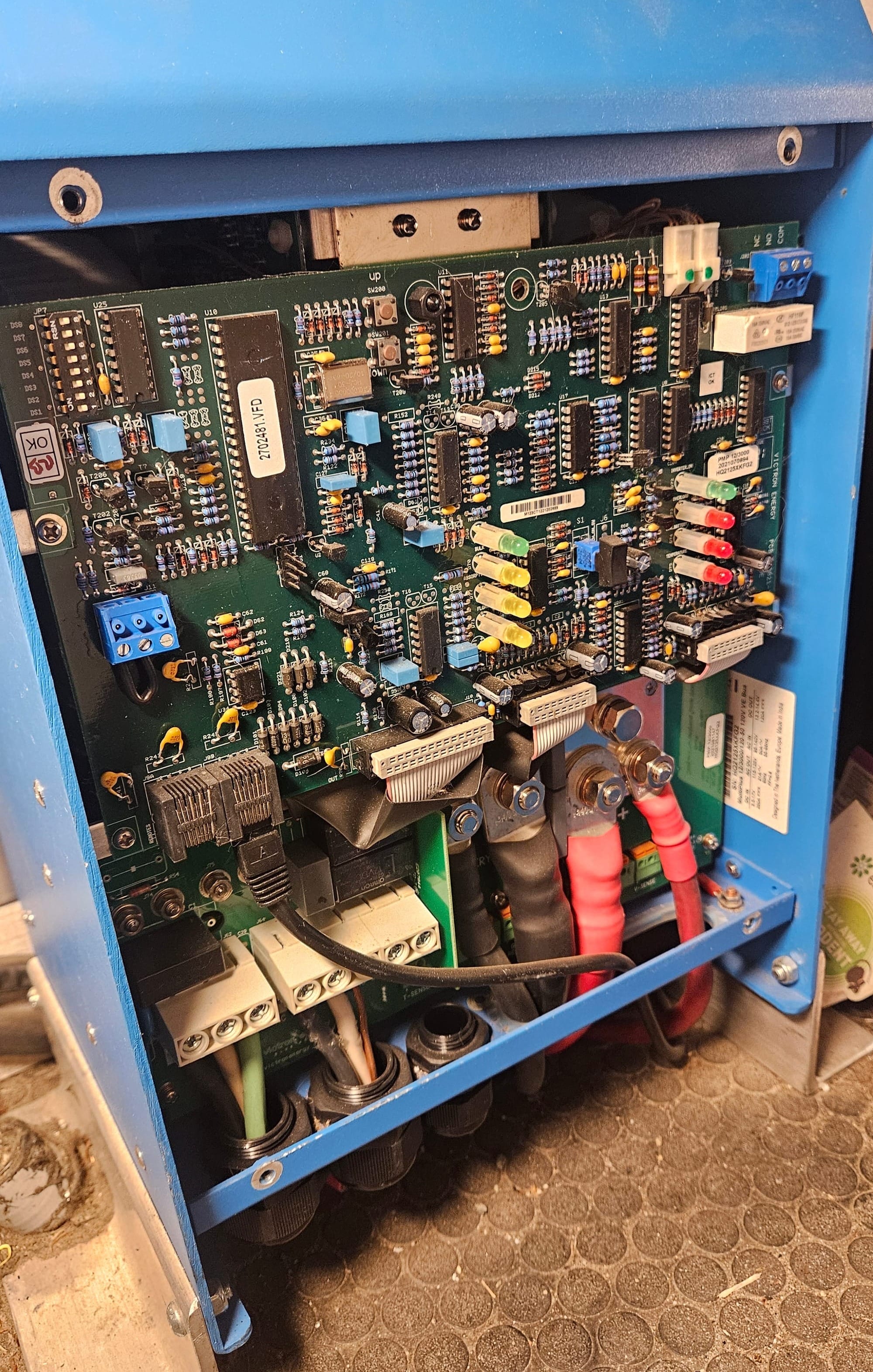
Even still, we dusted the components with our air compressor, and I messaged our solar installer, Boondoctor John, to get his professional opinion on what might be happening. We jumped on a phone call with a few goals:
- Figure out what the heck was going on
- See if the inverter was salvageable
- If it wasn't, John would teach me how to rewire the electric to bypass the inverter
It may have been in the 60s out, but the following day, the sun was going to bring the heat. The forecast was saying a high of 88°F. Since we live in an aluminum can, temperatures that high mean a very quick and steady climb to uncomfortable levels inside. We know this from personal experience...and we still had our elderly dog to think about.
We did everything we could on our troubleshooting call, and even got the inverter to turn back on after it cooled off. Success? Unfortunately, no. As soon as I turned it on, the burning smell came back. After letting it cool, doing more troubleshooting, and trying to restart it one more time, things got even worse:
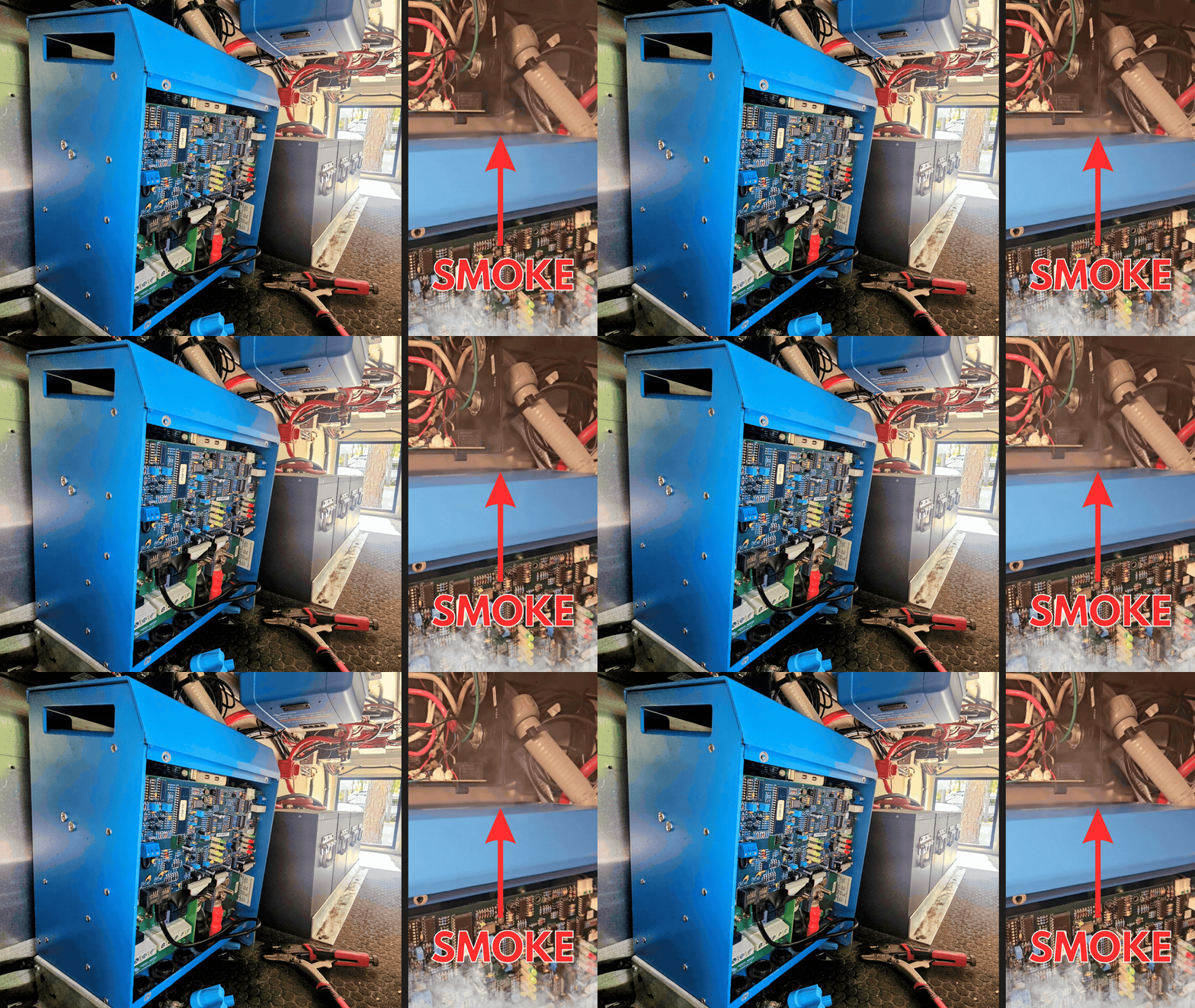
The inverter started making a loud clanking/humming noise, and smoke started emanating from the top. There was no way we could safely run this inverter. It was (almost literal) toast.
We had to face the fact that, unless we could bypass the inverter, we would be without power in temperatures in the upper 80s. Our only choice would be to get a hotel where Tanner could have air conditioning. Only problem is, Tanner's dementia has made him more sensitive to stress, especially if he needs to endure a sudden change of environment. We wanted to do everything we could to keep him in the RV. Boondoctor John walked me through the steps to rewire the cords so we could use our shore power, bypass the inverter, and use our old converter to get AC electric. It seemed like doable process. I now had practice crimping wires, though this would be a much higher voltage, and therefore higher stakes, situation. I also didn't have the right size butt connectors or wire nuts and would need to find a hardware store in the morning. Yemassee may be convenient to the interstate, but most of civilization is at least 20 minutes away. The closest hardware store, 10 minutes away, wouldn't open until 9:30am. The next nearest stores wouldn't open until 8am. I wanted to get started on the bypass as early as possible, before temperatures rose. I found a Lowe's 30 minutes away that opened at 6am, placed an order for the butt connectors, and woke up at 5am to drive down and pick them up.
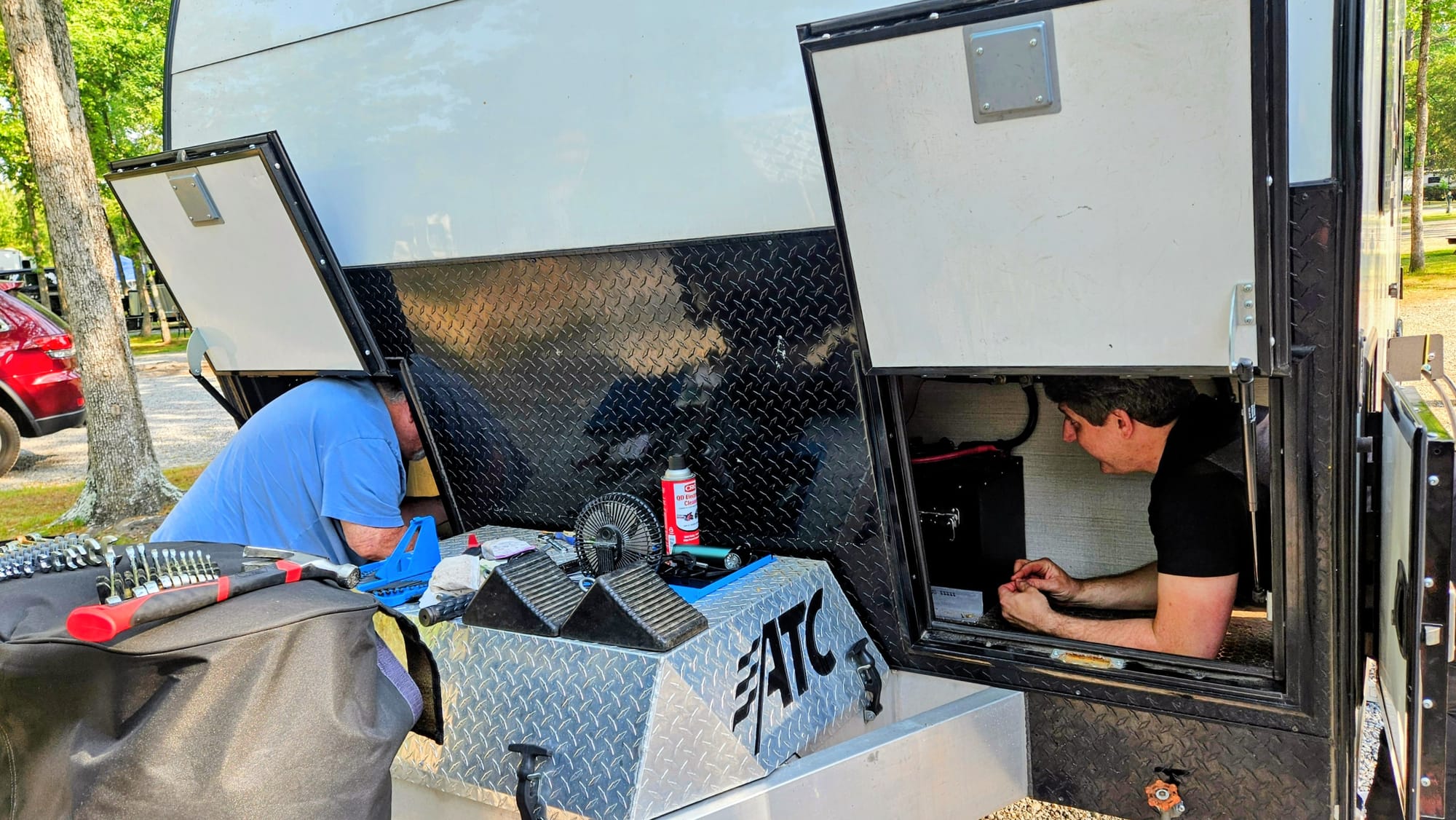
As soon as I got back to the KOA, I kicked into high gear, removing everything from the storage bay and getting all the tools out that I might need. Time was of the essence. The sun was getting higher in the sky and the temperatures were already rising.
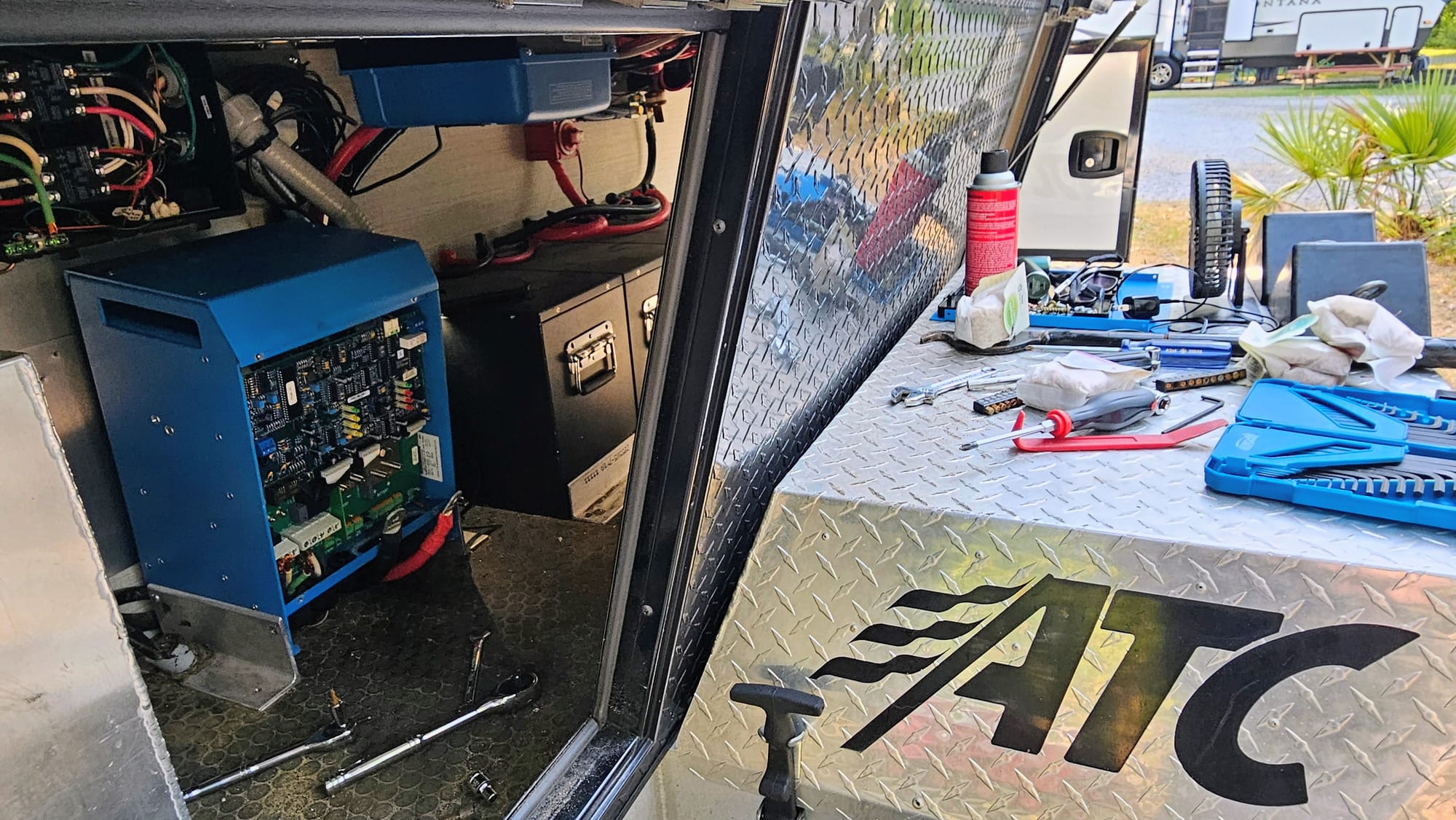
Luckily, the process for bypassing the inverter is very simple. There are 3 120V wires that bring shore power into the inverter from the transfer switch, and 3 more going out to the breaker panel in the rig. They're all color coded. I just needed to disconnect them from their junction boxes and re-connect them white to white, black to black, and green to...well, naked copper, but there was no chance of confusion.
There was just one problem. Boondoctor John is scrupulous and meticulous in his work. It's one reason why we trust him whole-heartedly. You might recall that it was his keen level of observation that kicked off our axle saga. But in this case, it means after he installs a component, he tidies up all the wires. Great for keeping things organized and preserving usable space in the storage bay. Less great for getting any slack out of those wires. After I loosened the terminal screws on the junction boxes, the wires were so tight I couldn't even pull them out!
After about a half hour of pulling, twisting, and bopping it without success, I decided I needed to approach the problem from a new angle. Literally. I figured if I could just unmount the inverter, I'd be able to tilt it enough to access more of the wires directly, and pull with more leverage. I would only need to remove four screws - either the four connecting the inverter to the mounting brackets, or the four holding the mounting brackets to the floor of the storage bay.
The problem is, the storage bay is really cramped. The screws connecting the inverter to the mounting brackets were secured by nuts, and the nuts were blocked by more wires. Since I couldn't get a wrench through to hold the nuts in place, turning the back screws did nothing. Meanwhile, the right side of the inverter was only inches from the batteries, and the mounting bracket screws on that side were also blocked by wires.
After seeing that we had some project ongoing, and in his words, it was "more exciting than driving," our neighbor Brian came by to offer help before checking out of his campsite. When we explained the problem, he dove right in with pliers, vice grips, and sheer determination. The RV community is always great about neighbors helping one another, but he went above and beyond, spending close to an hour yanking all six wires free, even though he needed to finish packing before checkout. Then when our connectors weren't fitting, he gave us a pack of gauge 6 wire nuts he happened to have lying around, a size Lowes hadn't had in stock.
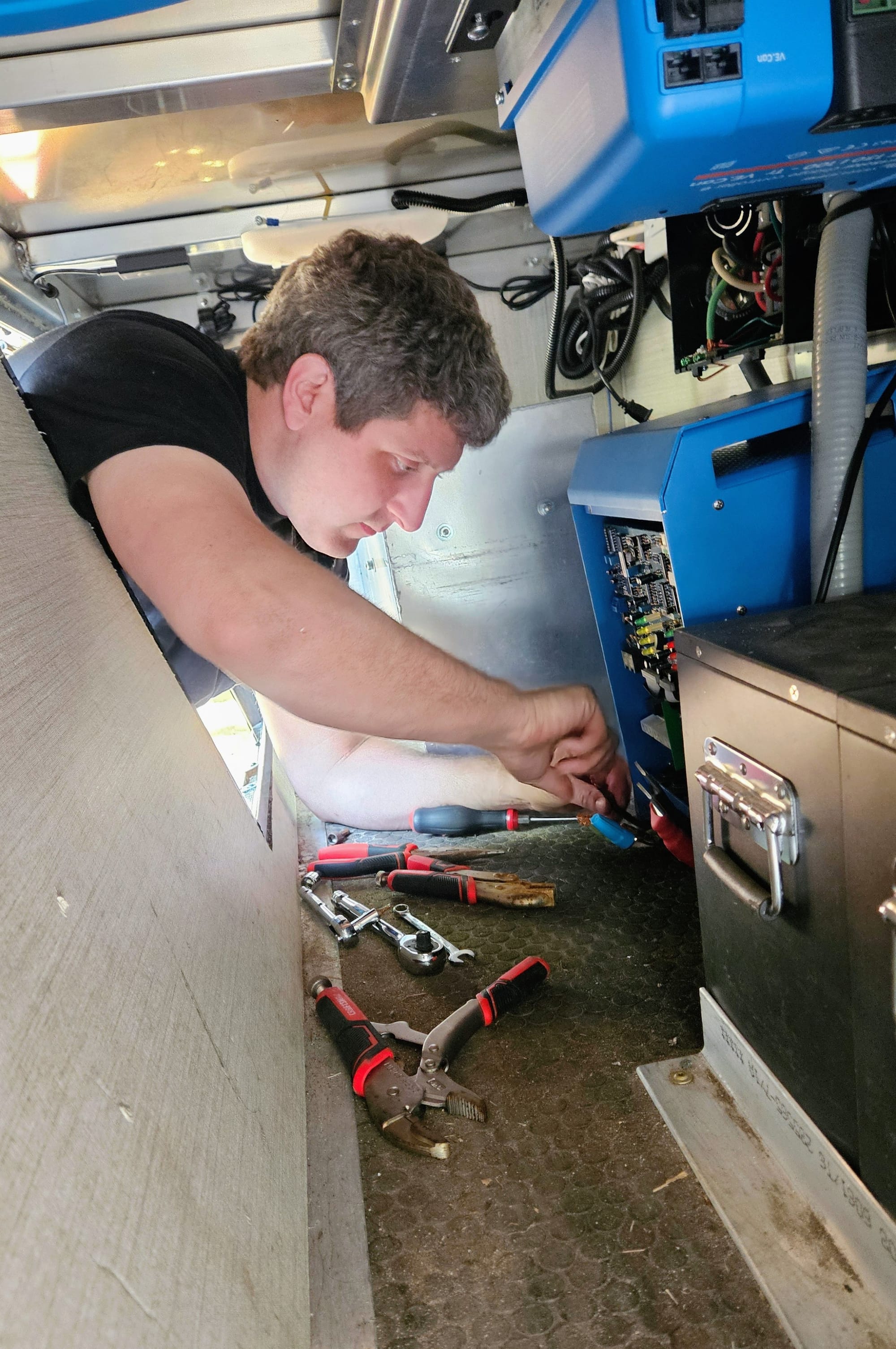
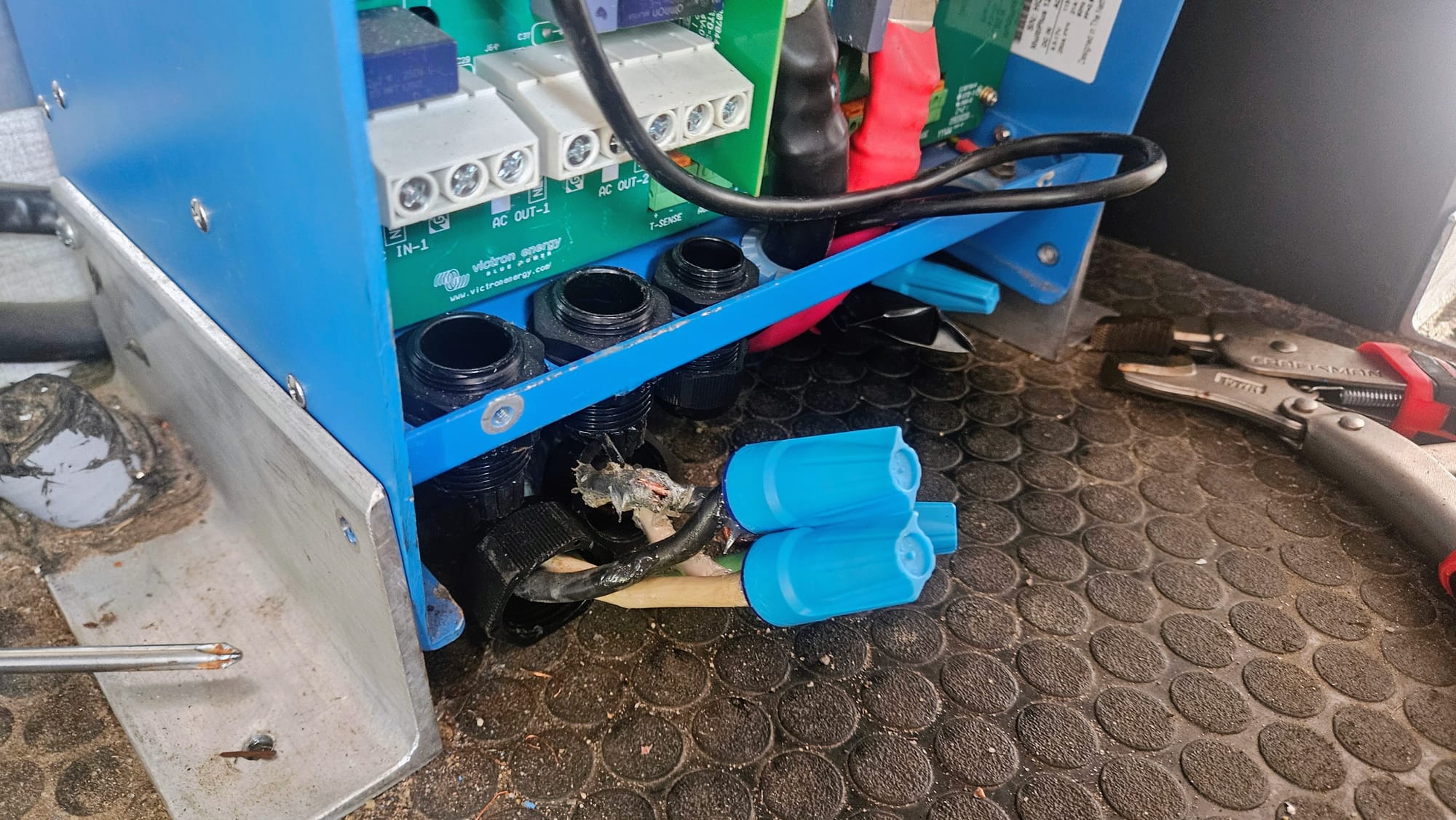
Once the wires were free, we were able to wiggle the inverter and mounting brackets just a little bit more, and it was enough to get the last mounting bracket screw free. A few minutes and some electrical tape later, the wires were spliced, and we had shore power back!
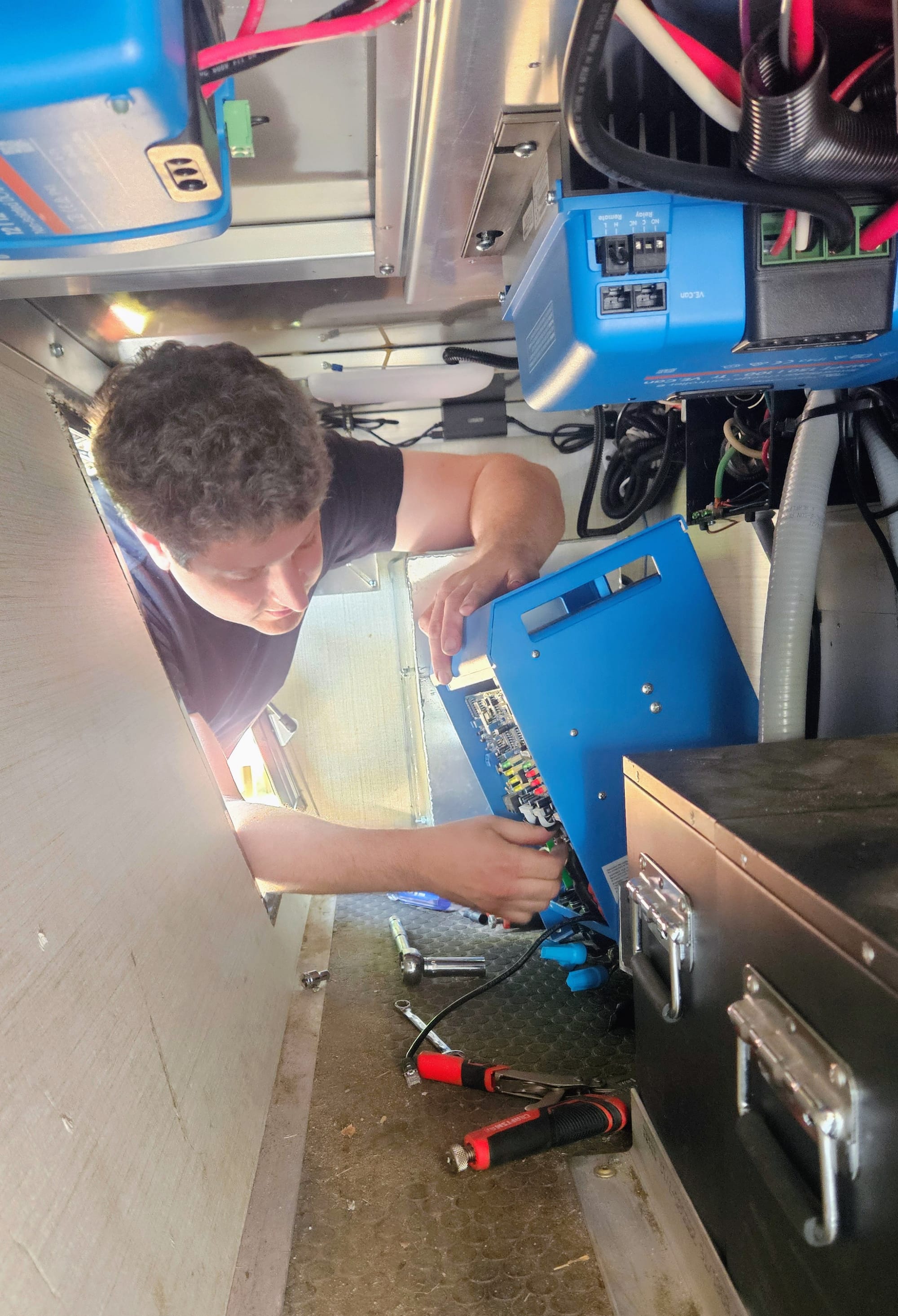
Except, we only had shore power back. Our 12V was out, even though I had voluntarily shut it off as a safety precaution. 12V runs our lights, fridge, USB outlets, and thermostats. In other words, we still couldn't use our air conditioning.
I quickly realized my mistake. Our inverter was also our converter and battery manager. All 12V power flowed through it on the way to and from the batteries. This meant there were wires I had capped that were actually still needed. Reconnecting them just required two nuts and bolts to hold the leads together, one for positive and one for negative. Only, I didn't have any bolts the right size. Fearing I'd need to return to the hardware store and spend more time we didn't have before it got too hot, I first looked closer: the KOA.
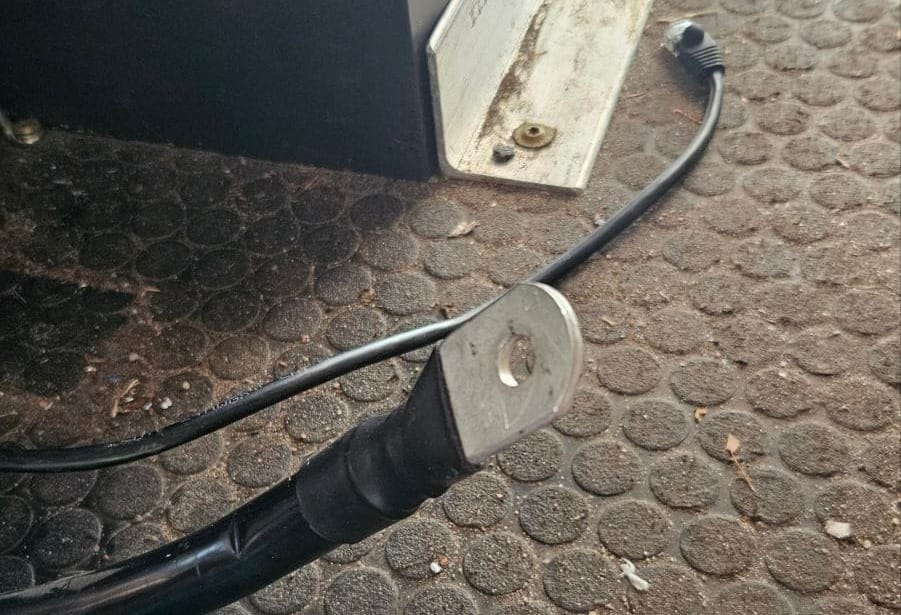
I stopped by the office, explained what was going on, and the lady at the coffee bar called her husband, who met me at our site. Minutes later, he came back with two nuts and bolts he had on hand. They fit!
And with that, we were back up and running...just a little more limited than we're used to. We basically reverted ourselves back to our original electric setup, pre-solar, only still with our solar panels and more battery amp hours. But until we could get our inverter replaced, we'd have limited use of appliances – 1 high-powered appliance at a time on 30amp hookups, 3 on 50amps, and running our generator if boondocking.
At the Yemasee KOA, we were on 30amp – for no other reason than Nicole wanted to save us $10/night, which with our inverter, makes no difference because we just supplement the amperage with our solar. We considered asking the KOA staff to move us to one of their 50amp sites, because that was the only way we could run both AC units. Then we thought about it some more. The high 80-degree temps were only lasting the couple of hours before sunset, and we had some tree cover in our site. We decided to see if we could get away with just one AC...and we could. After all our hard work, we saved ourselves some more. We didn't need to pack up and switch sites.
We took the win that we could comfortably stay in the trailer and continue traveling, but 2 questions hung over us:
- What on earth happened to our inverter?!
- How, where, and when could we get a replacement?
Once I got the inverter out of the storage bay, Nicole removed the top cover where the smoke was coming out, to see if anything looked scorched. We still couldn't see anything wrong! We started wondering about those early days of overheating. What if our inverter was defective from the start and we never knew?!
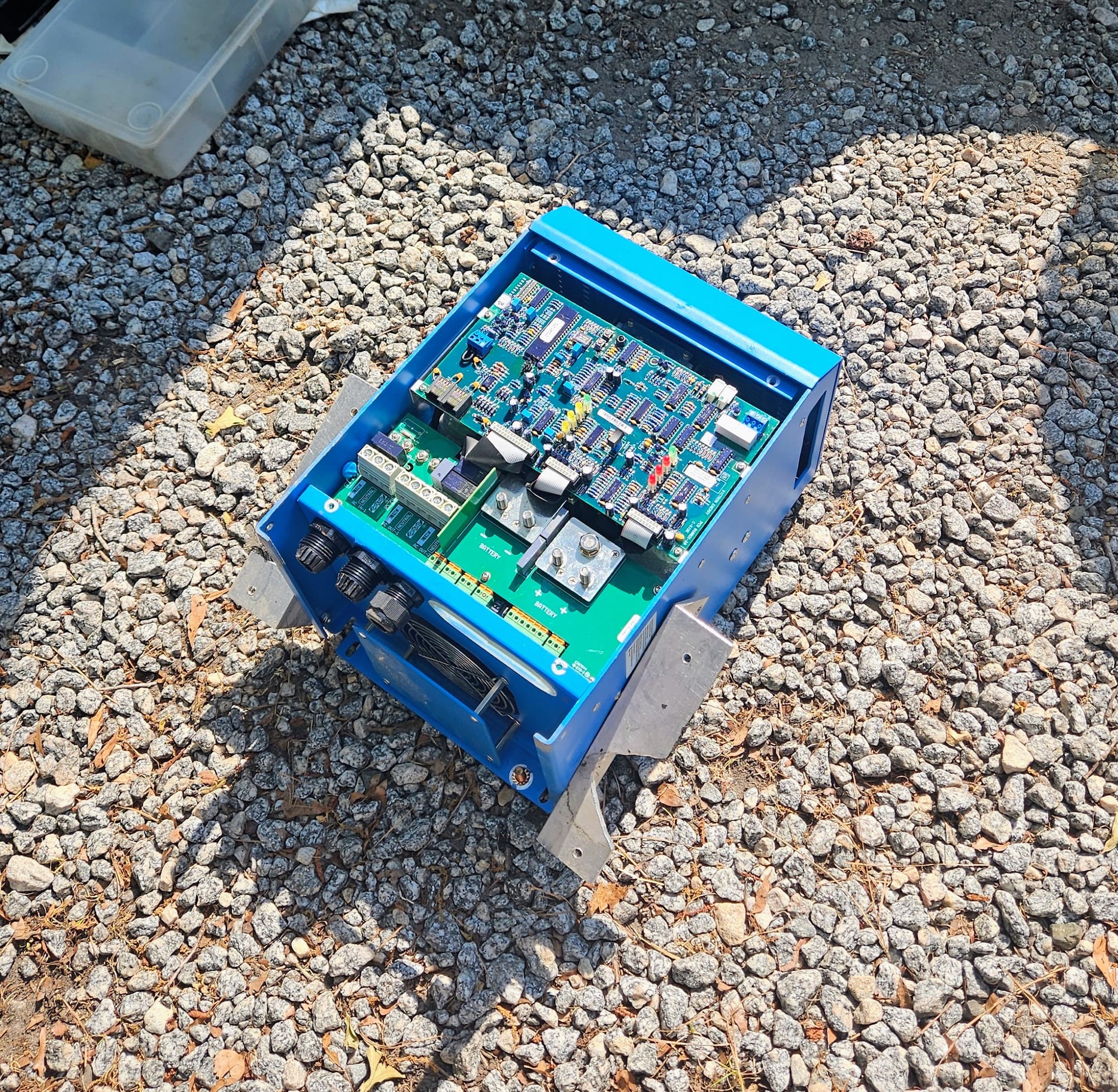
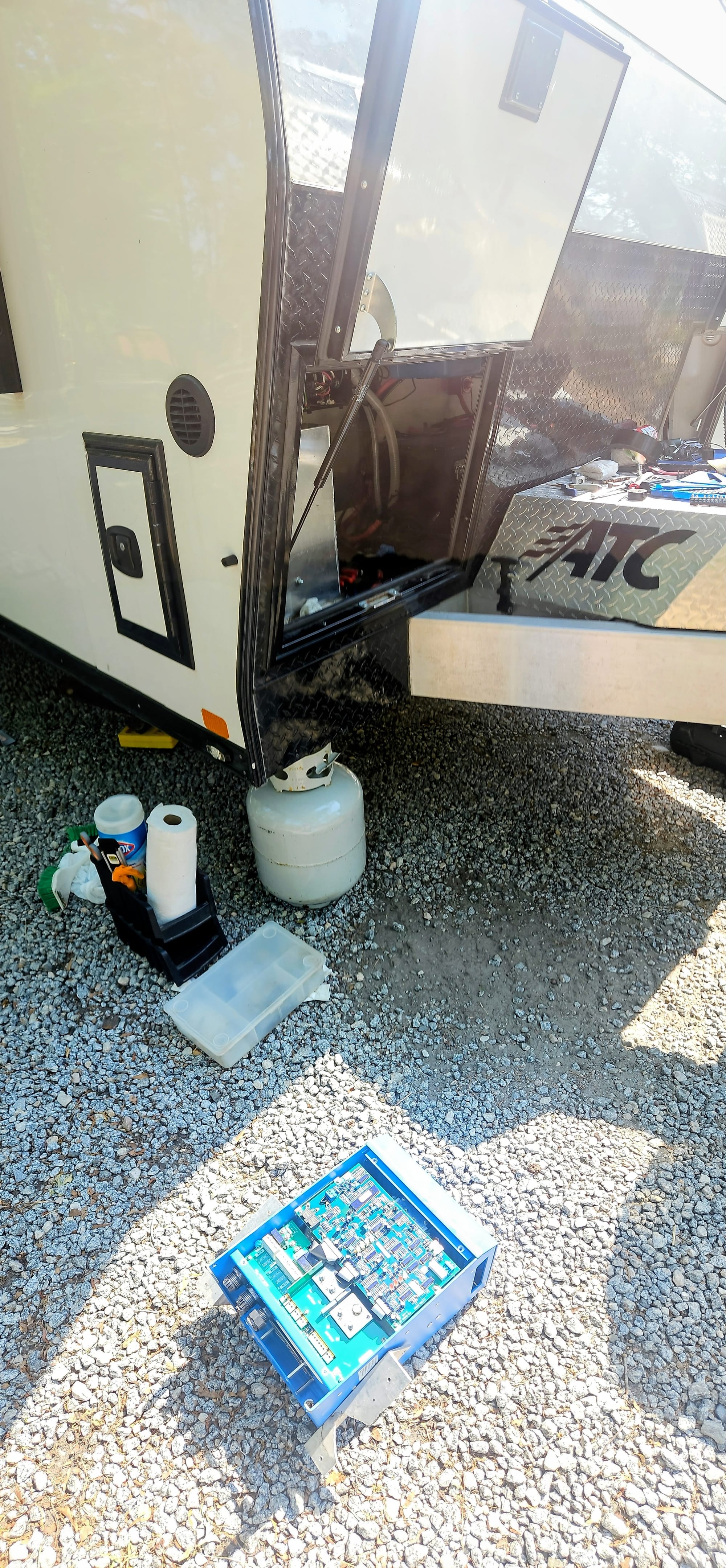
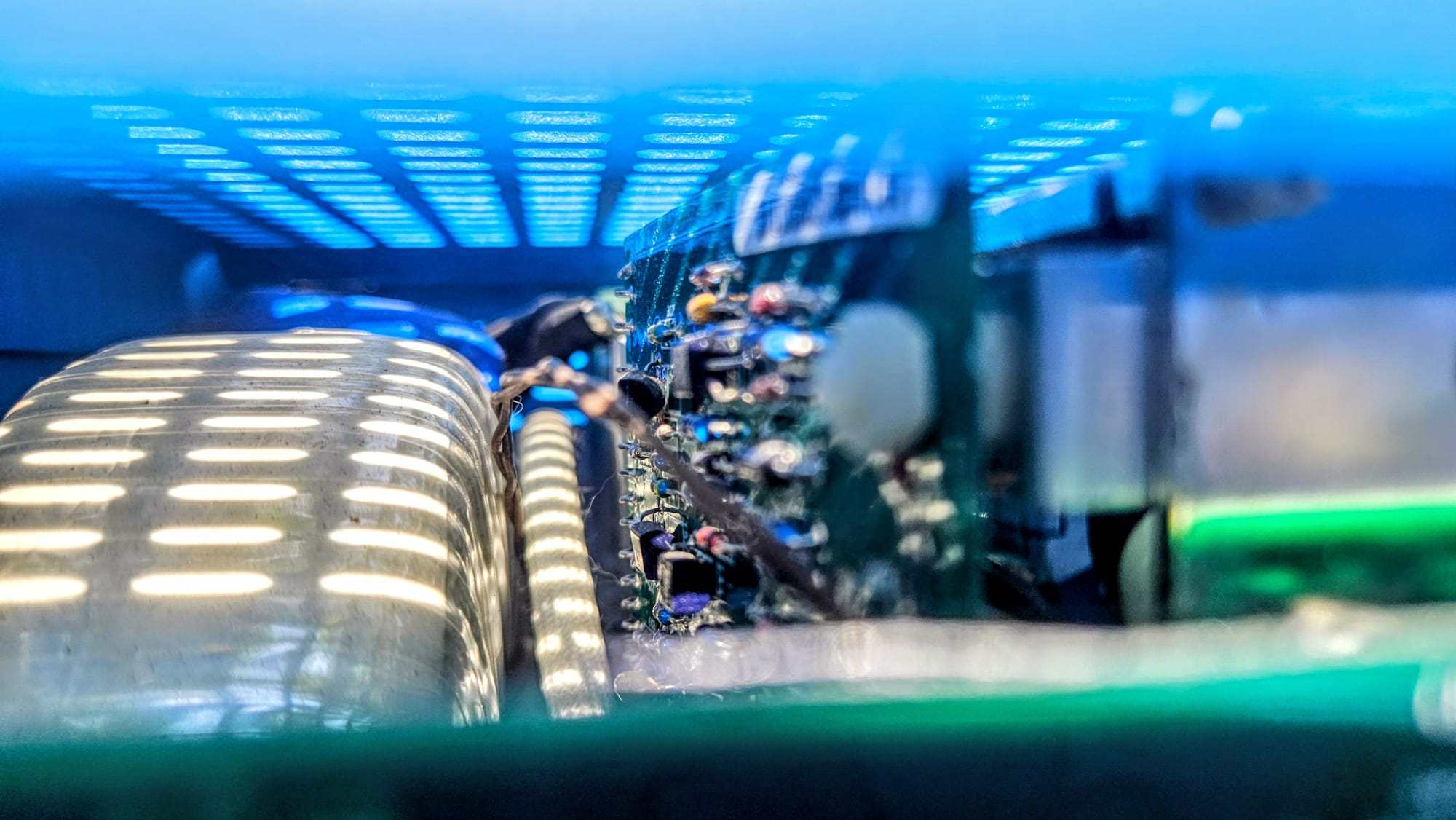
Then there were the responses we got from people when I started making calls about getting a replacement. I heard a number of remarks like, "This is the first we've ever heard of this type of problem in your inverter model." That's not something we want to hear. We might never figure out why our inverter did this, but as long as our new one doesn't try to spontaneously combust, we guess diagnostics on this one won't matter.
Ah yes...the new inverter. We wanted to get one installed as soon as possible. We had plans to return to New England for late spring, and no inverter would mean no ability to stay at either of our home-bases without constantly running our generator, aka paying gas prices up the wazoo. Victron, the company who makes our inverter, works through dealers, who have specialists that have been trained to install these components. I dove into research on who was qualified to replace an inverter in the Carolinas, and as luck would have it, came across EcoEthic Solar, located the next town over from our RV dealer, Trailers of the East Coast. This was perfect, because we had a service appointment there at the end of the week! If we could align our appointments to get our trailer repairs and inverter replacement at the same time, we could continue our travels and time our return to New England, with our inverter, and therefore be able to stay at our home-bases.
Unfortunately, I soon realized that this wouldn't be as simple as, "Submit the warranty paperwork and get a replacement." Boondoctor John had given me all the info to submit the claim myself, but Victron has a rule that only the distributor is allowed to process it. Because Boondoctor John is set up as a distributor and not just an installer, he'd need to process the claim. On top of that, Victron gave EcoEthic Solar pushback, saying we'd need to also get the install done by Boondoctor John. But there was a problem. John lives in Arizona, 2100 miles away.
Because Victron has a business-to-business structure, it was tough to find a way to contact them as a consumer, but after EcoEthic Solar ran into obstacles, I wanted to talk to Victron myself. After scrounging around on the web, I found the email address for the North American sales manager and sent him a message. To my pleasant surprise, he wrote back, and after a few emails back and forth, I got word that Victron would work with me to have John authorize the warranty claim and pass install off to another specialist.
At the same time, John was already submitting the paperwork to their warranty department and needed a shipping address. This is where things get complicated for full-timers. We don't have a home address we can send packages to. In this case, we had no solid RV park reservations, so we couldn't send the inverter to a campground. It's a big, heavy package that we'd ideally not want to haul around, and so the most sensical option was to see if we could get the replacement shipped directly to EcoEthic Solar. I contacted them and they agreed to receive the shipment.
Initially, we all hoped that EcoEthic Solar could provide us with a replacement inverter from their warehouse, which is right up the street from them. But we never learned if this was feasible, and eventually we acquiesced. We needed to wait for John to get warranty approval and for the inverter to ship. Then once it arrived to EcoEthic Solar, we could schedule a time for the install. John said that, once installed, he could program it to our panel remotely.
The plan was in place, but we had no clue how long each step would take. Every day, we were on the lookout for shipping info, and every day went by without news. Eventually, we faced a decision: Stick with our plans to go to New England inverter-less, or hang tight in the Carolinas for an unknown period of time. But before making that decision, we had to get through our other repairs, at Trailers of the East Coast. We wouldn't be making any big decisions until then.